

If you own a log home or are thinking about buying one, the question that keeps you up at night is simple: how much is this really going to cost me? The log home maintenance cost conversation is often clouded by vague estimates, contractor quotes that vary by tens of thousands of dollars, and well-meaning forum advice that may not apply to your specific climate or log species. This guide cuts through the noise. We will break down every major expense category using real-world numbers benchmarked to a standard 2,000-square-foot log home in the United States, with special attention to the high-altitude conditions of Colorado and Utah. Pencil Log Pros, led by U.S. Navy veteran Brad Siler, has spent decades restoring, repairing, and maintaining log homes throughout the Mountain West. By the end of this guide, you will know exactly where your money goes and how to avoid the number one mistake that turns a $5,000 problem into a $40,000 restoration.
Current rates: Maintenance-coat and recoat pricing in this guide comes from the Log Home Restoration Cost Index, the published per-square-foot rate card behind our estimates. It is reviewed quarterly.
Table of Contents
- Average Annual Log Home Maintenance Cost (2026 Benchmarks)
- Cost of Staining a Log Home
- Cost of Chinking and Re-Chinking
- Cost of Log Replacement and Rot Repair
- Cost of Media Blasting and Full Restoration
- Cost of Inspections and Preventative Maintenance
- Factors That Increase Maintenance Costs
- How Climate Affects Maintenance Expenses
- DIY vs. Professional Log Home Maintenance
- Hidden Costs Homeowners Often Overlook
- How to Reduce Long-Term Log Home Ownership Costs
- When to Repair vs. Replace Damaged Logs
- Signs Your Log Home Needs Immediate Attention
- Frequently Asked Questions
- Get Your Professional Log Home Assessment Today
Average Annual Log Home Maintenance Cost (2026 Benchmarks)
When homeowners ask about the cost of log home maintenance, they usually want a single annual number they can plug into a household budget. For a standard 2,000-square-foot log home, that smoothed figure lands around $1,350 per year. But here is the catch: log home maintenance does not work like a monthly subscription. The money leaves your account in lump sums every three to five years, and the annualized math simply helps you prepare for those spikes.
Breaking down the $1,350 figure reveals where the dollars actually go. You will spend roughly $150 annually on cleaning detergent, applied each spring to remove pollen, dust, and mildew before the summer sun bakes contaminants into the wood. The larger expense is stain, which averages about $767 annually. In reality, you buy 35 gallons of high-quality stain every three years at a cost of roughly $2,300 per application. Minor caulk touch-ups and pest-prevention treatments complete the remainder.
This baseline log home maintenance cost figure is critical to understand because it covers only preventative maintenance. It does not include log replacement, rot repair, media blasting, or structural work. Those are separate budget categories we will address in detail below. Brad Siler recommends that every log home owner establish a dedicated sinking fund of $150 to $200 per month. As he puts it, most homeowners are shocked by the lump sum, but the monthly cost is often less than a cable bill. When the three-year staining cycle arrives, the money is already sitting there, and the project does not become a financial emergency.
Cost of Staining a Log Home
Staining is the single most frequent major expense in the log home maintenance cost equation — and the one that most directly determines your total log home maintenance cost over time. and it is also the task where cutting corners produces the most expensive downstream consequences. Professional staining runs $1.75 to $6.25 per square foot of wall, from a maintenance coat to a full recoat. For a 2,000-square-foot home, that translates to $3,500 to $12,500 per application. The wide range depends on home height, accessibility, log condition, and the quality of stain selected.
Frequency is driven primarily by sun exposure. A first application on newly blasted logs typically lasts about two years before showing signs of degradation. Subsequent maintenance coats, applied over a stable stain system, can last up to 3 years. The wildcard is your south-facing gable. In Colorado and Utah, where high-altitude UV radiation is relentless, south and west elevations degrade roughly twice as fast as shaded north walls. Pencil Log Pros frequently performs spot treatments on these vulnerable elevations between full staining cycles, an approach that extends the overall system life and reduces the per-year cost.
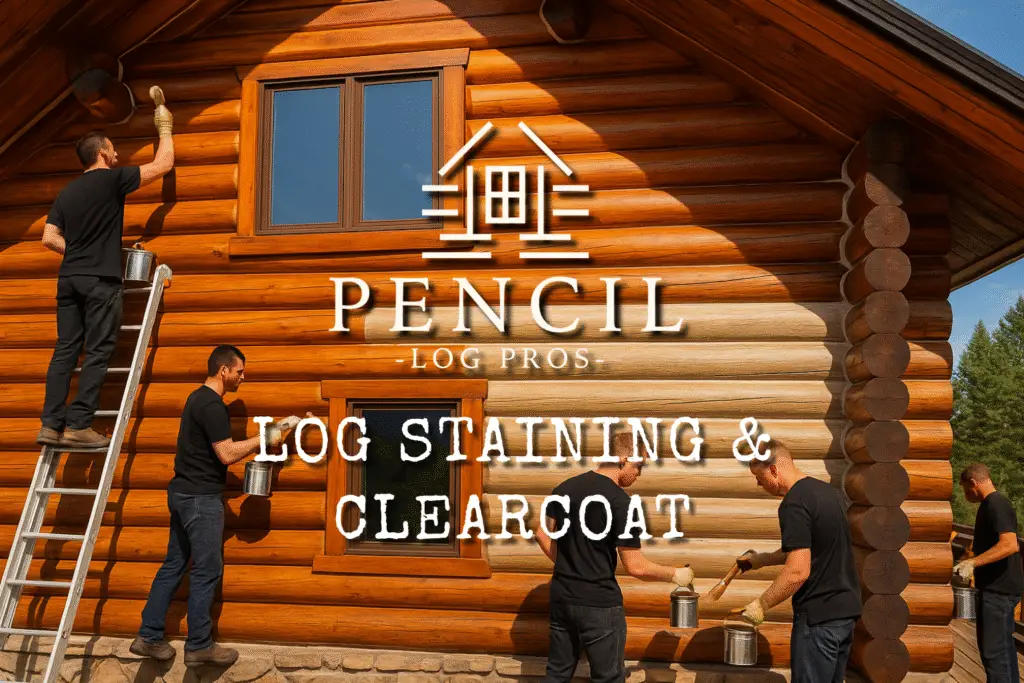
Product selection matters more than most homeowners realize. Budget stains from big-box stores may cost half as much upfront, but they often fail within 18 months, forcing you back onto the ladder far sooner. Premium penetrating stains from manufacturers like TWP and Sikkens cost more per gallon but extend the cycle, reducing your long-term log home maintenance cost. Brad Siler and his crew use a wet-on-wet application technique, spraying and back-brushing the second coat while the first is still tacky, which drives the stain deeper into the wood fiber and creates a more durable bond than conventional dry-between-coats methods.
DIY staining can save 40 to 50 percent of the log home maintenance cost on that specific task, bringing a 2,000-square-foot home down to roughly $1,500 to $2,500 in materials. The risks are uneven application, missed surface-preparation steps, and the very real danger of working on ladders or scaffolding for days at a time. A professional crew also carries insurance and warranty protection that a weekend warrior cannot match.
Cost of Chinking and Re-Chinking
Chinking is the flexible sealant that fills the gaps between log courses, and its condition directly determines whether your home stays dry and insect-free. Failed chinking is one of the most underestimated contributors to log home maintenance costs. The cost to maintain or replace chinking is measured in linear feet, not square footage, because the material runs along every horizontal joint in the structure. For general maintenance and touch-up work, expect to pay $3 to $8 per linear foot. Full removal of failed chinking and professional re-application runs $8 to $15 per linear foot.
Why does this matter so much? Failed chinking is the number one entry point for moisture and insects. A single gap no wider than a pencil lead can funnel water behind the log, where it sits against bare wood, feeds fungal growth, and initiates rot that eventually costs ten times what the chinking repair would have. In Colorado and Utah, freeze-thaw cycles are particularly brutal on chinking. Water enters a small crack, freezes overnight, expands, and mechanically widens the gap. Repeat this dozens of times each winter, and chinking that looked serviceable in October is failing by March.
Pencil Log Pros uses flexible, UV-stable compounds specifically engineered for high-altitude climates. These products move with the logs as they expand and contract in response to seasonal humidity swings. Signs that you need re-chinking include cracks wider than one-eighth of an inch, material that has pulled away from the log surface, visible gaps through which you can see daylight, and drafts you can feel on windy days. One hidden cost to anticipate: if your chinking has failed across large sections of the home, the stain system on those same logs is almost certainly compromised as well. Plan for a combined chinking and staining project rather than treating them as separate line items.
Cost of Log Replacement and Rot Repair
Rot repair is where log home maintenance cost conversations get serious. This is the category that separates preventative maintenance from emergency restoration, and the price tag escalates quickly as damage progresses. At the minor end, surface rot confined to a small area can be addressed for $500 to $1,500. The repair involves sanding away degraded wood fiber, consolidating the remaining sound wood with epoxy, and spot-staining to match the surrounding finish.
Moderate rot that penetrates deeper into the log but does not compromise the full cross-section requires a splice-in repair. The contractor cuts out the damaged section, scarfs in a new piece of log milled to match the existing profile, and integrates it with chinking and stain. These repairs typically run $1,500 to $3,500, depending on length and accessibility. Severe rot affecting more than half the log’s thickness, especially in a load-bearing wall, demands full log replacement. The crew must install temporary structural support, remove the entire damaged log, set a new one, and restore all surrounding chinking and stain. These projects start at $3,500 and can exceed $5,000 per log.
The iceberg warning is not a cliché in log home restoration. Visible rot on the exterior face of a log is often just the tip of the problem. Moisture travels along the log’s interior grain, and the real damage may extend several feet beyond what you can see. Brad Siler insists on moisture meter readings before any repair quote is finalized. Without that data, both the homeowner and the contractor are guessing.
Insect damage compounds rot repair costs. Carpenter ants and wood-boring beetles are common throughout Colorado and Utah, and they are often discovered only after the rotted wood is opened up. Treatment adds $300 to $800 to any repair project. The financial case for prevention is overwhelming: a $200 annual inspection catches rot when it is a $500 epoxy fix, not a $5,000 structural replacement.
Cost of Media Blasting and Full Restoration
Full restoration represents the highest possible log home maintenance cost, and it is reserved for homes where the stain system has completely failed, multiple incompatible coatings have been layered over each other, or years of deferred maintenance have left the logs in poor condition. The complete scope includes media blasting to remove all existing coatings down to bare wood, repairing any damaged logs, replacing failed chinking, and applying a new stain system from scratch. Blasting, re-chinking and the new stain system run $13.50 to $16.50 per square foot, and log repair is quoted on top after inspection. For a 2,000-square-foot home, that is $27,000 to $33,000 before log repair.
Media blasting alone, as a standalone service, costs $2.75 to $6.25 per square foot plus mobilization of up to $1,000, or roughly $5,500 to $13,500 for a 2,000-square-foot home. The process uses crushed glass, walnut shells, or corn cob grit propelled at controlled pressure to strip old coatings without damaging the wood substrate. It requires specialized equipment, containment measures, and respirators. This is not a DIY task under any circumstances.
How do you know if media blasting is necessary? Perform the water bead test. Spray water onto several sections of your logs. If the water beads up and runs off, your stain system is still functioning. If the water soaks in and darkens the wood, the stain has failed, and moisture is penetrating the log. Another test Brad Siler teaches homeowners: if you can scrape off the old stain with a fingernail, the coating system has lost adhesion and needs to be removed. Chemical stripping is sometimes presented as a cheaper alternative at $1 to $2 per square foot, but it is less effective on thick or multilayered coatings and introduces harsh chemicals into the soil around your home. Media blasting remains the gold standard for Pencil Log Pros because it produces a clean, profiled surface that optimally accepts new stain.
Cost of Inspections and Preventive Maintenance
A comprehensive log home inspection costs $300 to $600 and is the highest-return investment you can make in your property. According to the Log Homes Council, regular professional maintenance is the single most effective way to control log home maintenance costs and preserve structural integrity and property value. The inspection should include a visual assessment of all four elevations, moisture meter readings at multiple points on every wall, chinking integrity checks, stain adhesion testing, insect activity screening, and structural soundness evaluation of beams, posts, and log ends.
Pencil Log Pros recommends annual inspections in the spring, after snowmelt reveals any water damage that occurred over the winter. At a minimum, inspect every two years. The return on investment is not theoretical. A few hundred dollar inspection that catches a failed chinking joint before water penetrates the log behind it prevents the need for a $5,000 or more rot repair. Brad Siler states it plainly: he has never met a homeowner who regretted an inspection, and he has met hundreds who regretted skipping one.
What sets a professional inspection apart from a casual walk-around is the documentation. Pencil Log Pros delivers a detailed report with dated photographs, moisture readings mapped to specific locations, and a prioritized repair timeline that distinguishes between urgent safety issues, maintenance items to address this season, and conditions to monitor for future attention. This report serves as both a budgeting tool and a historical record of your home’s condition over time.
Factors That Increase Maintenance Costs
Several variables drive up your total log home maintenance costs, and understanding them helps you anticipate expenses rather than be surprised by them. Home size and complexity are the most obvious multipliers. A 4,000-square-foot home with multiple gables, dormers, and a wraparound porch has far more log surface area and linear feet of chinking than a simple rectangular cabin.
Log species play a significant role that few guides discuss. Pine, the most common log home species in the western United States, is relatively soft and absorbent. It requires more frequent staining and is more susceptible to rot than naturally decay-resistant species like cedar or fir. If your home is built from pine, budget for staining cycles on the shorter end of the three- to five-year range.
Accessibility adds cost in ways that are not obvious from a square-footage estimate. Remote mountain properties in Colorado and Utah often require contractors to travel long distances, and some homes are accessible only via roads that are challenging for heavy equipment. Steep lots may require scaffolding setups that take an extra day just to erect. Previous coating history is another major variable. Homes that have been painted or coated with multiple incompatible stain layers over the years almost always require media blasting before a new system can be applied, which turns a $4.75–$6.25 recoat into a $5.75–$7.25 strip and refinish, with the blasting included.
The single biggest cost multiplier, however, is deferred maintenance. A three-year delay on re-staining does not just mean the stain looks bad. It means the wood has been absorbing moisture for three years, and what would have been a $2,000 staining job has become a $20,000 restoration.
How Climate Affects Maintenance Expenses
Climate is not a background factor in log home maintenance costs. It is the primary driver of how fast materials degrade and how frequently you will be writing checks. In Colorado and Utah, high-altitude UV exposure is the dominant stressor. At 7,000 feet and above, the atmosphere filters out less ultraviolet radiation, and stain systems break down roughly twice as fast as at sea level. South and west elevations bear the brunt of this assault and may need attention every two years, even when the north walls look fine.
Freeze-thaw cycling is the second major climate mechanism. Moisture that penetrates a small check or chinking crack freezes at night, expands with tremendous force, and mechanically widens the opening. Over the course of a single winter, this cycle can repeat dozens of times, turning hairline cracks into structural gaps. This is why chinking and log repair costs tend to be higher in mountain climates than in more temperate regions.
The dry climate of Utah presents a different challenge. Low ambient humidity reduces the risk of fungal rot, which requires sustained moisture above roughly 20 percent wood moisture content. But rapid drying also causes logs to check and crack more aggressively, as the outer fibers shrink faster than the inner fibers. These checks become pathways for future moisture intrusion when rain or snow does arrive. Snow load adds another dimension. Heavy snow accumulation on roofs can mask leaks that only become apparent during spring melt, at which point water may have been seeping into log walls for weeks or months. Pencil Log Pros tailors maintenance schedules specifically for these regional stressors, and homeowners in Colorado and Utah should expect to budget on the higher end of national cost ranges.
DIY vs. Professional Log Home Maintenance
The do-it-yourself question comes up in almost every log home maintenance cost discussion, and the honest answer is that some tasks are well-suited to homeowner labor while others should never be attempted without professional equipment and training. DIY staining and basic chinking can save 40 to 50 percent on project costs. A homeowner willing to spend a week on ladders with a sprayer and brush can stain a 2,000-square-foot home for $1,500 to $2,500 in materials, compared to $3,500 to $12,500 for a professional crew.
The risks of DIY are not trivial. Improper surface preparation is the most common failure point. If the logs are not thoroughly cleaned and allowed to dry to the correct moisture content, even the best stain will peel within a year. Missed rot spots are another hazard. A homeowner may stain over a soft area without recognizing it as active decay, sealing moisture inside and accelerating the damage. Safety is a real concern as well. Working on scaffolding or extension ladders for days at a time, often on uneven ground, leads to serious injuries every year.
Annual cleaning, water bead testing, minor caulk touch-ups, and pest prevention are all reasonable DIY tasks that keep you connected to your home’s condition. Media blasting, structural log replacement, full re-chinking, and any repair involving moisture intrusion should be left to professionals. Brad Siler warns that DIY rot repair is often cosmetic. The homeowner sands away the visible damage and applies filler, but the moisture source behind the log was never eliminated, and the rot returns within a season or two. A professional repair addresses the cause, not just the symptom.
Hidden Costs Homeowners Often Overlook
Beyond the line items in a contractor’s proposal, several expenses catch log homeowners off guard and quietly inflate their log home maintenance costs. Disposal fees for old chinking, blasted media, and removed log sections run $100 to $500, depending on volume and local landfill rates. Pencil Log Pros charges mobilization of $0 to $1,000 only when media blasting is booked on its own; staining and chinking rates already cover travel and equipment. Multi-story homes require scaffolding, which adds $500 to $1,500 to a project and is sometimes listed as a separate line item.
Pest treatment is a common surprise. When media blasting or rot repair exposes insect galleries, fumigation or localized pesticide application adds $300 to $800 to the scope. Some counties in Colorado and Utah require permits for structural log replacement, adding another $50 to $300 in fees and potentially several weeks of processing time. If a full restoration takes two to three weeks and the home is not habitable during that period, temporary housing costs of $1,000 to $3,000 may apply.
The most insidious hidden cost is what contractors call the while-you’re-at-it trap. Replacing one rotted log often reveals that the adjacent log is also compromised, or that the chinking above and below has failed, or that the sill log resting on the foundation has moisture damage that was invisible from the exterior. Budget a 15-20 percent contingency above the quoted price for unforeseen damage. If you do not need it, you keep the money. If you do need it, the project does not stall while you scramble for financing.
How to Reduce Long-Term Log Home Ownership Costs
Reducing your lifetime log home maintenance cost is not about finding the cheapest contractor or stretching stain cycles an extra year. It is about systematic prevention that keeps small problems from becoming capital projects and your log home maintenance cost from compounding year over year. Annual inspections are the foundation. A trained eye with a moisture meter finds issues when they are $500 fixes, and that same issue left undiscovered for three years becomes a $5,000 repair.
Be proactive about staining. Do not wait for visible peeling or chalking. As soon as the water bead test fails and water soaks into the wood rather than beading on the surface, schedule your staining crew. The wood is still sound at that point, and the job is a straightforward clean-and-coat rather than a restoration. Gutter maintenance is unglamorous but essential. Clean gutters twice a year to prevent water from splashing back onto log walls during heavy rain or snowmelt. Vegetation management is equally important. Trim trees and bushes so that no foliage touches the logs, and maintain at least two feet of clearance to reduce moisture retention and pest access.
South-facing shade is one of the most cost-effective investments you can make. Planting deciduous trees or installing awnings on southern and western elevations dramatically reduces UV exposure, extending stain life on the most vulnerable walls. The maintenance fund we discussed earlier, $150 to $200 per month in a dedicated savings account, removes the financial shock from the three-to-five-year cycle. When the bill arrives, the money is waiting. Finally, partner with a specialist who knows your region. Pencil Log Pros offers a Log Home Repair Estimator that provides homeowners with a quick preliminary estimate based on their home’s specifics, making financial planning straightforward before any commitment is made.
When to Repair vs. Replace Damaged Logs
The decision to repair or replace a damaged log has a significant impact on your overall log home maintenance costs and depends on the depth, extent, and structural role of the damage. Repair is appropriate when damage is localized to less than two linear feet, confined to the outer portion of the log, and not affecting the log’s load-bearing capacity. These repairs use epoxy consolidation for surface rot or scarf splicing for more serious but still partial damage. Costs range from $500 to $1,500, and the work can often be completed in a day or two.
Full log replacement becomes necessary when rot extends through more than 50 percent of the log’s cross-section, or when the log is in a load-bearing wall, and its structural integrity is compromised. These replacements cost $1,500 to $5,000 per log and require temporary shoring, careful extraction, and precise fitting of the new log to match the existing profile and appearance.
Brad Siler teaches a simple field test that any homeowner can perform. Take a screwdriver and press it into the suspect area. If it sinks more than 1 inch under moderate pressure, the log has lost structural integrity and should be replaced rather than repaired. Pencil Log Pros specializes in matching log species, profile, and weathering so that replacements blend seamlessly with the surrounding wall. A well-executed log replacement should be invisible to anyone who does not know exactly where to look.
Signs Your Log Home Needs Immediate Attention
Some log home problems can wait until the next budget cycle. Others demand immediate action — and delaying them can dramatically increase your log home maintenance cost. Water stains or dark streaks running down from chinking lines indicate moisture intrusion behind the stain system. Peeling or bubbling stain means the coating has failed and is trapping moisture against the wood. Soft or spongy wood that yields under thumb pressure signals active rot.
Cracks wider than one-quarter inch are direct pathways for water and insects to reach the log’s interior, where damage can progress unseen for years. Visible insect frass, the fine sawdust that carpenter ants and beetles push out of their galleries, means insects are actively tunneling inside your logs. Drafts or cold spots along walls indicate failed chinking that is also letting moisture through. A musty or moldy smell inside the home points to hidden moisture, creating conditions for decay.
If you observe any of these signs, do not wait for your next scheduled maintenance cycle. Use the Pencil Log Pros Log Home Repair Estimator for a fast preliminary assessment of what you might be facing, then schedule a professional inspection to determine the full scope of the problem. The difference between acting now and waiting six months can easily be thousands of dollars in additional damage.
Frequently Asked Questions
How much does log home maintenance cost per year?
For a 2,000-square-foot log home, plan on approximately $1,350 per year, averaged over a three- to five-year maintenance cycle. This includes cleaning, staining, and minor chinking touch-ups. Major repairs such as log replacement, rot repair, and media blasting are separate expenses not included in this annualized figure. A monthly sinking fund of $150 to $200 is the most practical way to prepare for the lump-sum expenses that occur every few years.
How often should a log home be stained?
Every three to five years is the standard interval. The first application on bare or freshly blasted wood typically lasts about two years. Subsequent maintenance coats applied over a stable stain system can last up to three years. South-facing elevations in high-altitude climates like Colorado and Utah may require spot treatments or more frequent full applications due to intense UV exposure.
What is the most expensive log home repair?
Full restoration — the peak of log home maintenance cost — which includes media blasting to bare wood, log repair, complete re-chinking, and application of a new stain system, runs $13.50 to $16.50 per square foot before log repair, which is quoted after inspection. For a 2,000-square-foot home, that totals $27,000 to $33,000 plus any log repair. This level of restoration is typically required when maintenance has been deferred for many years or when incompatible coatings have been layered.
Does homeowner’s insurance cover log home repairs?
Generally, no. Homeowner’s insurance covers sudden and accidental damage from covered perils such as fire, windstorm, hail, or falling trees. Gradual deterioration from rot, UV damage, insect infestation, and failed maintenance is almost universally excluded. Some insurers offer log home endorsements that provide limited coverage for specific perils. Review your policy carefully and discuss log home-specific coverage with your agent.
Is log home maintenance more expensive than traditional homes?
Yes. A conventional stick-built home typically costs about one percent of its value annually in maintenance. A log home costs two to three percent due to the specialized staining, chinking, and rot prevention it requires. The exterior of a log home is a wood finish system exposed to the elements, and like any exterior wood finish, it demands regular attention.
How do I estimate log home repair costs?
The fastest way to get a preliminary estimate is to use the Pencil Log Pros Log Home Repair Estimator. This tool provides a ballpark figure based on your home’s size, location, and visible condition. For an accurate, binding quote, schedule a professional inspection that includes moisture meter readings and a detailed scope of work. Surface-level estimates without moisture data often miss hidden damage and lead to budget overruns.
Get Your Professional Log Home Assessment Today
Preventative log home maintenance cost is dramatically lower than major restoration expenses. A few hundred-dollar inspection today can save you $40,000 tomorrow. That is not marketing language. It is the mathematical reality of log home ownership, confirmed by decades of restoration projects where small, ignored problems became structural crises.
Do not guess about your log home’s condition. Use the Pencil Log Pros Log Home Repair Estimator for a quick preliminary estimate to help you plan your finances. Then request a professional log home inspection and detailed quote from a team that has spent decades restoring log homes throughout Colorado and Utah. Led by Brad Siler, a U.S. Navy veteran who brought military precision and integrity to the construction trades, Pencil Log Pros understands the unique climate challenges of high-altitude log structures.
Many homeowners underestimate repair costs because hidden moisture intrusion, UV damage, insect activity, failed stain systems, and deteriorated chinking often exist beneath the surface where untrained eyes cannot see them. Let our experts find what you cannot. Request your professional quote today — Pencil Log Pros serves Colorado and Utah mountain communities.