

Owning a log home in the Crested Butte area is a dream for many, a tangible piece of the Colorado high country that offers unmatched rustic beauty and a direct connection to the surrounding wilderness. But that dream comes with a set of responsibilities unique to building with wood at 9,000 feet of elevation. The same elements that make this valley so stunning, the relentless sun, the deep, drifting snow, and the dramatic temperature swings, are actively working to degrade your home’s exterior every single day. Proper Crested Butte, CO log home restoration is not a cosmetic luxury; it is the essential, recurring investment that stands between your cabin and a slow, costly decline into structural decay. At Pencil Log Pros, we approach every project with a deep understanding of this local reality. This article will serve as your comprehensive guide to understanding why log homes deteriorate so aggressively here, what a professional restoration actually entails, and how to plan and budget for the work required to keep your home standing strong for decades.
Table of Contents
- Why Crested Butte Log Homes Face Unique Deterioration Challenges
- The Pencil Log Pros Difference: Local Expertise for Crested Butte & Gothic
- Our Core Log Home Restoration Services in Crested Butte, CO
- Log Home Restoration Cost Guide for Crested Butte, CO (2026 Update)
- DIY vs. Professional Log Home Restoration: What You Can (and Can’t) Do
- The 2026 Log Home Maintenance Calendar for Crested Butte
- Frequently Asked Questions About Log Home Restoration in Colorado
- Ready to Protect Your Crested Butte Log Home? Schedule Your 2026 Inspection
Why Crested Butte Log Homes Face Unique Deterioration Challenges
The lifespan of a log home’s finish and structural integrity is determined almost entirely by its environment, and few environments in the lower 48 are as punishing as Gunnison County. We often refer to the combination of forces at play here as the high-altitude triple threat. Understanding each element is the first step in grasping why a maintenance schedule that works for a home in a milder climate will fail here.
The first and most constant aggressor is ultraviolet radiation. At elevations ranging from 8,800 feet in Crested Butte South to over 9,500 feet in places like Gothic, the atmosphere is thinner and filters significantly less UV light. This intense solar bombardment breaks down the lignin in exposed wood fibers, causing the surface to turn gray and brittle. It also rapidly degrades protective stains and clear coats. You can see this effect most dramatically on south- and west-facing walls, where a finish that was applied just three years ago may already be peeling and faded, while the shaded north side still looks nearly new.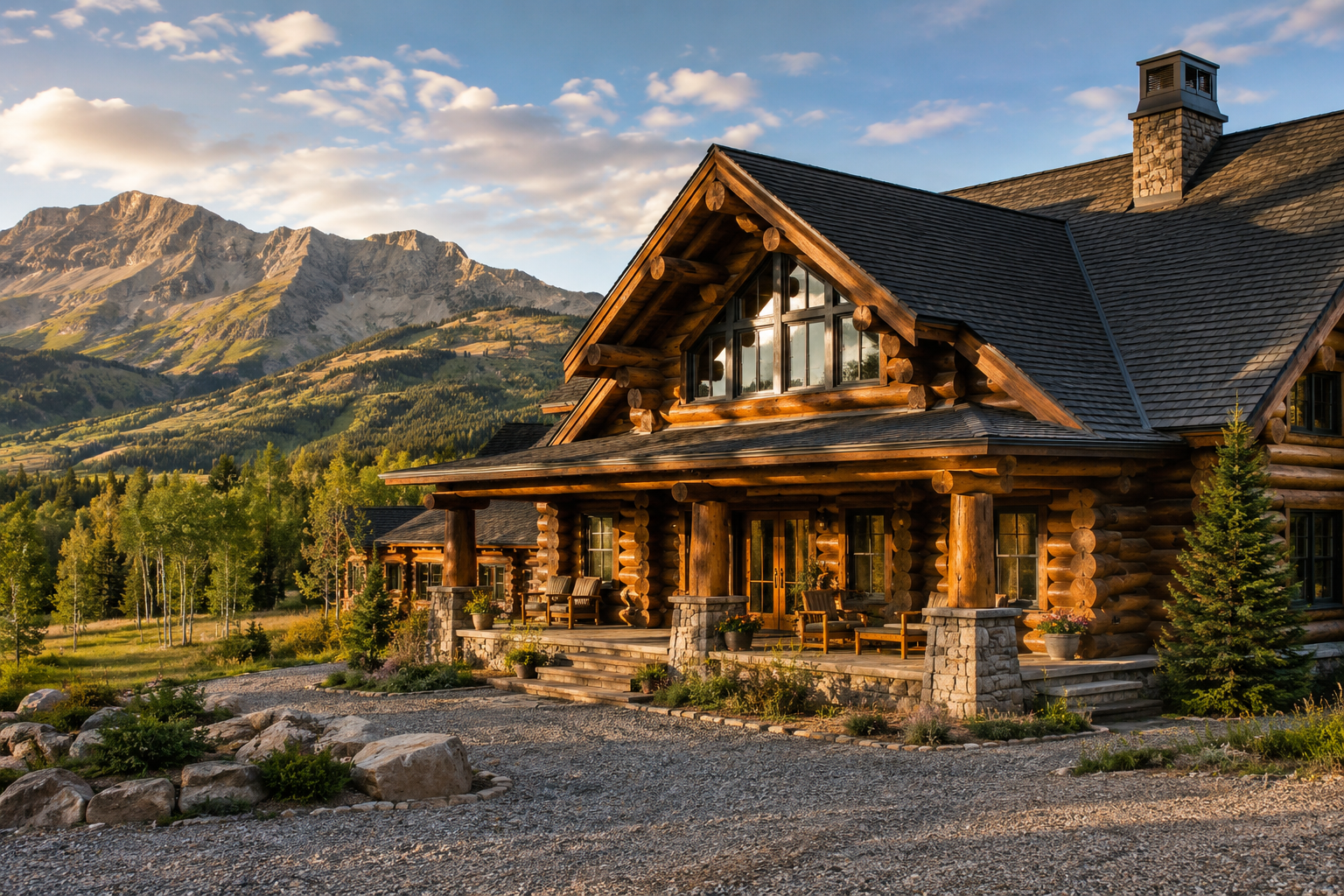
The second threat is the extreme and rapid thermal cycling. It is not uncommon for Gunnison County to record the coldest temperatures in the nation on a winter night, plunging to -40°F. When the sun hits those same frozen logs the next morning, the surface temperature can swing by 60 or 70 degrees in a matter of hours. Wood expands when it warms and contracts when it cools. This constant, daily movement works like a slow-motion pry bar on every seam, joint, and check in your logs, cracking rigid sealants and opening gaps that invite moisture inside.
The third element is moisture, delivered primarily by the legendary snowpack that can reach 250 inches in a heavy year. This is not a gentle, soaking rain. The snow creates specific, aggressive damage patterns. Steep-pitch metal roofs, a common and necessary design feature here, shed snow in sudden, heavy slides that can scrape and batter lower log courses, deck railings, and window trim. As the snow accumulates on the ground, it forms deep banks that can sit directly against the sill logs for five or six months. This prolonged contact wicks moisture deep into the wood, creating the perfect conditions for rot at the very base of your home. Adding to this, the bright spring sun reflects off that lingering snowpack, directing intense UV radiation upward against the bottom logs and deck posts, a phenomenon we call reflective burn that accelerates damage from below. All of these forces combine to create a compressed, urgent work season. The dependable window for blasting, staining, and chinking runs roughly from mid-June into early October, making early planning not just a convenience, but a necessity for securing a spot on a qualified contractor’s schedule.
The Pencil Log Pros Difference: Local Expertise for Crested Butte & Gothic
When you choose a restoration partner, you are not just hiring a crew with equipment; you are hiring a body of knowledge. Pencil Log Pros brings decades of high-country experience to every project, with a focus that is specific to the wood species and architectural styles of this valley. The majority of log homes in the Crested Butte area are built from local conifers, primarily lodgepole pine and Engelmann spruce. These are beautiful, workable woods, but they are softer than species like Douglas fir or cedar. This means an overly aggressive restoration technique, like heavy sanding, can irreparably damage the wood’s surface, eroding the natural grain and reducing the log’s diameter. Our team is certified by industry leaders like Sashco and Perma-Chink, and we use media blasting techniques that are precisely calibrated to remove failed coatings without harming the soft wood fiber underneath.
Our local expertise extends beyond the wood itself to the unique logistical challenges of the area. This is especially true for our work in Gothic, Colorado. As a former mining town turned seasonal alpine research outpost, Gothic presents a set of challenges that a general contractor from a lower elevation simply would not anticipate. The access roads are rough and seasonal, the work sites are often remote historic cabins with no modern utilities, and the short summer window is even tighter at that elevation. Restoring these structures requires meticulous logistical planning to ensure all materials, equipment, and crew are on-site during the brief period when conditions are viable. It is a job that demands respect for the historic character of the buildings and a practical understanding of high-alpine work.
That same level of detailed local knowledge applies to our work throughout the broader valley. We are intimately familiar with the home styles in the subdivisions of Crested Butte South, and we understand the specific patterns of weather exposure on Mt. Crested Butte. We do not offer a generic log home service; we offer a Crested Butte log home service. This means we position ourselves as a full-service restoration company, not just a maintenance crew. Our capabilities range from minor chinking repairs and a fresh coat of stain to major structural interventions, including log splicing, full log replacements, and repairing damage from years of neglect. We see ourselves as stewards of your home’s long-term health, capable of handling any challenge this climate can create.
Our Core Log Home Restoration Services in Crested Butte, CO
A complete restoration is a multi-stage process, and cutting corners on any single stage will compromise the entire project’s longevity. Our core services are designed as an integrated system to address every vulnerability your home faces.
Media Blasting and Surface Preparation is the critical first step that defines the quality of the final result. The goal is to remove every trace of old, failing stain, dirt, and oxidized wood fiber to create a clean, porous surface for new coatings to bond with. We use a media blasting process, typically with crushed glass or walnut shells, that is far gentler than sanding. Sanding a softwood like Engelmann spruce can create a burnished, closed-off surface that resists stain penetration. Our blasting technique erodes only the damaged material, leaving the sound wood with a fine texture that is ideal for absorbing a new stain deeply and evenly. This process requires extensive containment and specialized equipment to protect your windows, landscaping, and the surrounding environment.
Once the logs are bare, we can fully assess the extent of any structural damage. Log Repair and Splicing is a surgical process. We identify sections of logs that have rotted, often at the sill level from snow contact or at the corners where water has penetrated. Instead of replacing an entire log, which is often unnecessary and prohibitively expensive, we cut out the damaged section and splice in a new, kiln-dried log that matches the original species and profile. The joint is carefully sealed and secured, and when the restoration is complete, the repair is virtually invisible. This method preserves the integrity of your home while solving the problem at its source.
With the logs sound and bare, we move to sealing. Chinking and Sealing for Extreme Temperatures requires a deep understanding of material science. The sealants we use are specifically engineered for the massive expansion and contraction cycles of a high-altitude log home, remaining flexible and adhesive at temperatures ranging from -40°F to 180°F. A critical detail that is often overlooked by inexperienced applicators is the proper installation of a backer rod. This closed-cell foam rod is inserted into gaps before the chinking is applied. It creates a proper two-point adhesion joint, prevents the sealant from sticking to the back of the gap, and allows the material to stretch and compress freely without tearing.
The final and most visible step is Staining and UV Protection. We apply high-quality, breathable, semi-transparent stains that are formulated with powerful UV blockers. The breathability is non-negotiable in this climate. A film-forming stain or paint will trap moisture inside the logs, causing it to rot from the inside out. Our stains allow any internal moisture vapor to escape while shielding the wood from liquid water and solar radiation. We pay special attention to the south and west walls, often applying an additional coat to these high-wear surfaces. This process extends to your exterior living spaces as well. Our Deck and Railing Refinishing service addresses the specific problem of snow scrape damage, restoring the wood and applying a durable, UV-resistant finish that can stand up to the abrasive forces of a Crested Butte winter.
Log Home Restoration Cost Guide for Crested Butte, CO (2026 Update)
One of the most common and difficult questions we receive is about cost. A log home restoration is a significant investment, and providing a single, one-size-fits-all price without an inspection would be a disservice. The final cost is driven by several highly variable factors that can only be assessed in person.
The primary driver is the home’s square footage and current condition. A 2,000-square-foot cabin with a stain that is simply faded but still intact will cost far less per square foot than a home of the same size where the stain has completely failed, leaving bare, gray, and checked wood. Accessibility is another major factor. A home in a drive-up subdivision in Crested Butte South is more straightforward to service than a remote cabin in Gothic that requires navigating a rough, seasonal road and potentially bringing in generators and water. The need for structural repairs, such as log splicing or sill replacements, adds to the total project cost but is essential for the home’s integrity.
With those variables in mind, we can provide some general ballpark figures for 2026 to help you start your budgeting process. A basic maintenance package involving a gentle wash and application of a clear water repellent or light maintenance coat might fall in the range of $1.75 to $3.25 per square foot of wall area. A full restoration, which includes media blasting to remove all old coatings, full chinking, and application of a premium stain system, runs $13.50 to $16.50 per square foot, with any log repair quoted separately after inspection. Chinking, when priced on its own, runs $7.75 to $9.25 per effective square foot, meaning only the share of wall that actually carries joints.
Be wary of bids that fall far below these ranges. A low-ball offer almost always signals a plan to cut corners, such as pressure washing instead of media blasting (which drives water deep into the logs), using a cheap acrylic caulk that will fail in one winter, or applying a single coat of a big-box store stain with minimal UV protection. The hidden cost of this cheap work is a premature and more expensive full restoration just a few years down the road. The only way to get an accurate, binding quote for your specific home is through an on-site inspection. We need to see the condition of your logs, test the existing finish, and assess the site logistics. We encourage you to schedule this inspection early, as our summer calendar fills quickly.
DIY vs. Professional Log Home Restoration: What You Can (and Can’t) Do
Many log home owners are hands-on people who take pride in maintaining their property. There is a place for DIY work, but knowing the boundary between a safe homeowner task and a job for a professional is critical to avoiding costly mistakes.
What you can safely do yourself centers on observation and light maintenance. The most valuable task is an annual visual inspection. Twice a year, in late spring and late fall, walk around your entire home with a notepad. Look for new cracks, gaps in the chinking, signs of pest activity like pine beetle boreholes or carpenter ant frass, and any areas where the stain is peeling or the wood looks gray. You can also gently wash your home using a specialized log cleaner and a soft-bristle brush to remove surface dirt and mildew, but never use a pressure washer. The high pressure forces water into the wood grain and can cause irreversible damage. Applying a clear water repellent to small, easily accessible areas is another manageable task.
There are, however, clear lines you should not cross. Any task that requires specialized equipment or where a mistake can trap moisture inside the logs is a job for Pencil Log Pros. Media blasting is the prime example. It requires an industrial air compressor, a blasting pot, the correct media, and extensive containment to protect your property and the environment. Log splicing and replacement are structural work that must be done with precision to ensure the new wood bears weight correctly and doesn’t create new gaps as it settles. Chinking is a deceptive task. It looks simple, but improper backer rod installation or using the wrong sealant will lead to adhesion failure within a single freeze-thaw cycle, and removing failed caulk is a tedious nightmare. Finally, any work on a ladder or scaffolding above a single story, particularly on the massive south-facing gable walls, should be left to professionals with proper safety gear and insurance. The risk of a DIY mistake at 9,000 feet is not just a poor aesthetic result; it is the potential for trapping moisture that will rot your logs from the inside, turning a $10,000 maintenance project into a $50,000 structural repair.
The 2026 Log Home Maintenance Calendar for Crested Butte
The compressed nature of our warm season means that timing is everything. Following a seasonal maintenance calendar will help you stay ahead of the deterioration and coordinate effectively with your restoration contractor.
Late Spring (May/June) is the critical assessment and booking window. As soon as the snow melts back from your foundation, conduct a thorough post-winter inspection. Look for popped or cracked chinking, new log-end checks, signs of rodent entry, and any splash-back damage on the lower logs. This is the moment to call Pencil Log Pros and schedule your on-site inspection and project slot. By June, our summer schedule is often fully booked.
Early Summer (July) offers the warmest and most stable weather, making it the prime window for the heavy work. This is the ideal time for media blasting and applying the first coats of stain. We prioritize the south and west walls during this period to get the most UV-vulnerable surfaces protected as early as possible.
Late Summer (August) continues to provide excellent conditions for staining and is the best time for chinking and detailed caulking work. The consistently warm temperatures allow these flexible sealants to cure slowly and achieve maximum adhesion before the first cold snaps of autumn.
Fall (September/October) is the final window for touch-ups and winter preparation. We can complete final coats of stain and address any last-minute gaps. Homeowners should focus on clearing gutters and ensuring that snow slides from the roof will not be obstructed, potentially creating ice dams that can force water back under the roofing material.
Winter (November-April) is a time for passive monitoring. If you live in the home full-time, keep an eye on interior humidity levels; excessively dry air can cause excessive interior log checking. For absentee owners, the long winter is the greatest threat. A small leak that goes unnoticed for five months can cause catastrophic damage. If possible, schedule a mid-winter check by a caretaker or neighbor to look for signs of water intrusion or ice damming. This simple step can prevent a devastating surprise come spring.
Frequently Asked Questions About Log Home Restoration in Colorado
How often should a log home be stained in Crested Butte?
Due to the intense UV radiation at this altitude, the south- and west-facing walls of your home will typically need to be re-stained every 3 to 5 years. The north and east sides, which receive far less direct sun, can often go 5 to 7 years between applications. The best way to tell is a simple water test: sprinkle water on the logs. If it beads up, the finish is still protecting the wood. If it soaks in and darkens the wood, it is time for a maintenance coat.
What causes log home chinking to fail?
Chinking failure is almost always a result of improper installation or the wrong material choice. The extreme temperature swings in Gunnison County cause logs to expand and contract significantly. If a backer rod was not installed correctly, or if a rigid, non-elastic caulk was used, the sealant will tear away from one side of the joint. Once that bond is broken, water enters and the failure accelerates. We use high-elasticity sealants and proper backer rod techniques to ensure a bond that lasts for decades.
Can you restore a log home yourself?
You can perform minor maintenance like gentle cleaning and visual inspections. However, a full restoration involving media blasting, log splicing, or full chinking replacement requires professional equipment, materials, and a deep knowledge of how to avoid causing further damage. A mistake like using a non-breathable stain can trap moisture and cause rot that will cost many times more to repair than the original restoration would have.
Is log home restoration covered by homeowners insurance?
Typically, no. Homeowners insurance covers sudden and accidental damage from events like a fire, a tree falling on the house, or a severe storm. The gradual deterioration of your home’s finish from sun and weather is considered a maintenance responsibility, much like replacing a worn-out roof. You should always check your specific policy, but you should plan to budget for restoration as a recurring maintenance cost.
What is the best stain for high-altitude log homes?
The best stain is a high-quality, breathable, semi-transparent stain formulated with a high concentration of UV blockers and trans-oxide pigments. We rely on top-tier products from manufacturers like Sashco and Perma-Chink, which are specifically engineered for the extreme conditions of the Rocky Mountain West. These stains create a flexible, breathable barrier that blocks UV radiation while allowing any moisture inside the logs to escape, preventing rot and peeling.
Ready to Protect Your Crested Butte Log Home? Schedule Your 2026 Inspection
Your log home is more than just a building; it is a legacy and a significant financial asset in one of the most beautiful places on earth. Protecting it requires a partner who understands not just the craft of restoration, but the specific, unforgiving climate of the Crested Butte, Crested Butte South, and Gothic areas. Pencil Log Pros is that partner. We combine decades of high-country experience with industry-leading materials and a genuine commitment to the long-term health of your home.
The window for 2026 work is short and the demand is high. Do not wait until the snow melts to start planning. Contact us today through our official Crested Butte, CO service page to learn more and schedule your comprehensive on-site inspection. Secure your place on our summer calendar and ensure your home is ready to stand strong against whatever the next Rocky Mountain winter brings.
Further Reading
For the wood-science background on high-altitude UV exposure and finish performance, see the USDA Forest Products Laboratory Wood Handbook.