
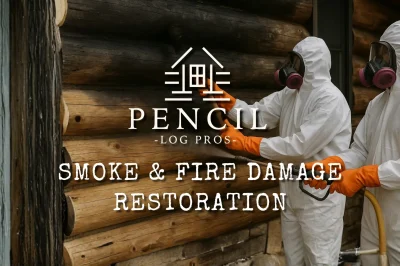












Fire Damage Restoration for Colorado Log Homes (Expert Fire & Smoke Restoration)
When a fire strikes a log home in Colorado, the aftermath is more than char, soot, and smoke. At altitude, our dry climate and intense UV accelerate deterioration, while firefighting water can drive moisture deep into the wood fiber. Pencil Log Pros specializes in log-specific Fire Damage Restoration and comprehensive Fire & Smoke Restoration—from emergency mitigation through stain and finish rebuild—so your cabin looks right, smells clean, and performs for the long haul.
Why Fire & Smoke Damage Hits Log Homes Differently in Colorado
Log structures behave unlike stick-built walls. Heat opens checks and grain, allowing soot to pack into pores, and smoke odor to migrate through natural cracks. At Colorado elevations (5,000–10,000+ ft), UV and freeze–thaw cycles can rapidly degrade compromised finishes after a fire.
- Soot, creosote & char in the grain: Residues embed deep into checks, knots, and corner notches. Wiping can smear carbon and stain the wood.
- Odor absorption: Pine, spruce, fir, and cedar are porous; smoke volatiles lodge in fiber, chinking, and tongue-and-groove ceilings, requiring a true Fire & Smoke Restoration odor protocol, not just surface cleaning.
- Water intrusion: Firefighting saturates logs, subfloors, and cavities. Without mapped drying, hidden moisture leads to mold and future rot.
- Altitude stress: High UV and low humidity speed up finish failure on previously heated wood if it isn’t properly neutralized and rebuilt.
Our Fire & Smoke Restoration Process (What to Expect)
We follow a proven, log-specific workflow so nothing is missed. Every step is designed to protect healthy wood, eliminate soot and odor, and return the home to safe, livable condition.
1) Emergency Response, Board-Up & Tarping
We secure openings, stabilize roof and deck penetrations, and set negative-air containment if needed. Early control stops weather and wildlife from turning damage into destruction.
2) Fire Damage Inspection & Written Scope
Our techs document every room and elevation. We grade smoke impact, test for char depth, map moisture, and produce a transparent scope for Fire Damage Restoration with photos you can share with your insurer.
3) Debris Removal & Contents Triage
Non-salvage items are carefully removed to expose surfaces. We identify restorable contents and coordinate specialty cleaning where appropriate.
4) Soot Removal from Log Surfaces
We choose gentle, controlled techniques—HEPA vacuuming, dry-chem sponges, and media blasting (soda or corn cob) where needed. The goal is to remove carbon without over-abrading the wood.
5) Surface Neutralization & Detail Cleaning
After soot removal, surfaces are pH-balanced and detailed to break down acidic residues. This prepares logs for successful refinishing later in the project.
6) Odor Elimination (Fire & Smoke Restoration Odor Protocol)
We pair mechanical cleaning with the right deodorization technologies: thermal fogging for complex cavities, hydroxyl for occupied spaces, and ozone for unoccupied, sealed conditions. Ducts and returns are cleaned to remove fine particulates.
7) Structural Drying & Dehumidification
Targeted air movers and dehumidifiers dry logs, subfloors, and cavities based on meter readings—not guesswork. We track progress and document drying logs daily.
8) Char Removal, Resurfacing & Fiber Stabilization
Where heat compromised wood, we remove friable char to sound fiber. Surfaces are refined to an even profile, minimizing “shadowing” that can telegraph through finishes.
9) Log Repair, Replacement & Rot Mitigation
Our craftsmen execute Dutchman patches, scarf splices, or partial log replacements. We integrate borate treatments to deter future decay and insects in previously wet sections.
10) Chinking & Sealant Restoration
Heat and soot often break bonds at joints. We remove failed sealants, re-prep, and apply high-performance chinking/caulk to re-seal the building envelope.
11) Stain & Finish System Rebuild
Finish is rebuilt in layers with UV-stable products suited to elevation and exposure. We run on-wall sample panels to match existing color tones for seamless blends in partial repair areas.
12) Interior Cleaning & IAQ Validation
Final HEPA cleaning is followed by particulate checks and odor verification. We pursue “nose-blind” checks and client walkthroughs to ensure comfort before sign-off.
Specialized Services for Log Homes After a Fire
- Species-specific care: Pine, spruce, fir, and cedar each respond differently to heat and cleaning; we adapt methods by species and profile (round, D-log, square).
- Media blasting for soot: Precision blasting removes embedded carbon in checks and corners that hand cleaning can’t reach.
- Color matching & blending: We test stains in sun and shade to avoid “patchwork” finishes after Fire & Smoke Restoration.
- Decks, rails & outbuildings: We restore connected structures exposed to heat and smoke so the entire property feels consistent.
- Window & door rehab: Resetting trim, seals, and weather-stripping that warped or lost adhesion during the event.
Insurance Coordination & Documentation
We speak carrier language and keep homeowners in control. Our documentation streamlines approvals and keeps momentum on your project.
- Photo & moisture logs: Each phase is documented for claims and future maintenance records.
- Transparent line-item scopes: You see what’s included and why—no surprises.
- Safety & compliance: Containment, PPE, negative air, and HEPA protocols are standard in our Fire & Smoke Restoration work.
Colorado Climate Factors We Always Account For
- UV intensity at altitude: We select finish systems with proven UV resistance for 5,000–10,000+ ft conditions.
- Dry air & rapid swings: Drying and cure windows are planned around low humidity and daily temperature swings.
- Snow, ice & runoff: We protect newly restored surfaces from meltwater staining and splash-back at grade.
- Wildfire smoke seasons: Our Fire & Smoke Restoration odor protocols address recurring smoke events that re-soil exterior logs.
Example Fire Damage Restoration Projects
Wildfire Smoke Intrusion – Foothills Cabin
Challenge: Widespread smoke odor, fine soot on round-log walls, and HVAC contamination. Solution: Containment, HEPA cleaning, hydroxyl deodorization, and duct cleaning. Result: Zero detectable odor, finish intact, and improved indoor air quality.
Kitchen Fire – Main Level Log Wall & Ceiling
Challenge: Localized char, greasy soot, and blistered finish over the cooktop. Solution: Targeted media blasting, neutralization, partial stain rebuild with color blending. Result: Seamless match to adjacent walls and restored luster.
Chimney Flue Event – Great Room Gable
Challenge: Heat damage to purlins and smoke staining on high vaults. Solution: Scaffold access, char removal, Dutchman repairs, stain system rebuild. Result: Structural integrity restored and even, UV-resistant finish.
Tips for Homeowners Recovering from Fire & Smoke Damage
- First 24–48 hours: Don’t wipe soot on logs; it can grind carbon into the grain. Avoid running the HVAC. Photograph everything and call a log-home specialist in Fire Damage Restoration.
- Ventilation with control: Light ventilation helps, but avoid spreading soot. Negative-air containment is safer during professional cleaning.
- Protect what’s clean: Keep doors to unaffected rooms closed and place walk-off protection on high-traffic paths.
- Plan for finish rebuild: After cleaning and odor work, budget time for stain and topcoat to fully cure at altitude.
Why Choose Pencil Log Pros for Fire & Smoke Restoration
- Log-home specialists: Our team restores round, D-log, and square-log structures every day—this is our lane.
- End-to-end delivery: One contractor for mitigation, repairs, chinking, and stain/finish rebuild ensures consistency and speed.
- Colorado-proven systems: Products and processes selected for UV, low humidity, and freeze–thaw realities.
- Odor gone—guaranteed: We combine source removal, surface neutralization, and professional deodorization for a result you can live with.
- Clear communication: You’ll know what’s happening, what’s next, and what it costs—no jargon, no surprises.
For guidance on wildfire recovery programs and federal disaster assistance available to Colorado property owners, the USDA Forest Service Disaster Recovery program provides resources on post-fire land stabilization, hazard mitigation, and recovery coordination for affected homeowners.
Related Log Restoration Services
- Log Staining & Finishing to rebuild UV protection after Fire Damage Restoration.
- Chinking & Sealant to re-seal joints and prevent drafts and moisture.
- Rot Repair & Insect Prevention for areas impacted by firefighting water or delayed drying.
- Deck Refinishing to restore rails, treads, and posts exposed to heat and smoke.
Colorado Service Areas
We mobilize quickly across the Front Range, foothills, and high country for fire and smoke restoration, as well as fire damage restoration. Explore our local teams: Locations We Serve
FAQs: Fire Damage Restoration & Fire & Smoke Restoration
How fast can you start Fire & Smoke Restoration?
We prioritize emergency calls with same-day stabilization whenever possible. Board-up, containment, and initial HEPA cleaning begin the recovery clock.
What’s the difference between soot cleaning and full Fire Damage Restoration?
Soot cleaning removes visible residue. Full Fire Damage Restoration also addresses odor at the source, structural drying, char removal, repairs, chinking, and finish rebuild—essential for log homes.
Will smoke odor return after restoration?
Not when source removal, surface neutralization, and the correct deodorization technologies are applied. Our Fire & Smoke Restoration protocol is designed for lasting results.
Can you match my original stain color?
Yes. We produce on-wall samples in sun and shade and blend transitions to avoid “patchwork” looks common after partial repairs.
Is ozone or hydroxyl better for occupied homes?
Hydroxyl is preferred for occupied spaces. Ozone can be effective in unoccupied, sealed conditions. We’ll choose the right tool based on materials and occupancy plans.
Do you work with insurance?
We provide detailed scopes, photos, and moisture logs aligned with carrier requirements and keep you updated at every step.
What about decks, railings, and outbuildings?
We include connected structures in our Fire & Smoke Restoration plans so the property feels cohesive when complete.
How long does the new finish take to cure at altitude?
Cure times vary by product and weather. We plan application windows for low humidity and temperature swings and advise when surfaces are ready for normal use.
If only smoke (no flames) reached my home, do I still need professional restoration?
Yes. Smoke particulates and odor can embed deep in logs and ductwork. Professional Fire & Smoke Restoration ensures residues are removed and air quality is restored.
What should I do before your crew arrives?
Limit traffic in affected rooms, avoid wiping soot, and set aside essential documents or valuables. We’ll handle protection, containment, and cleaning.