
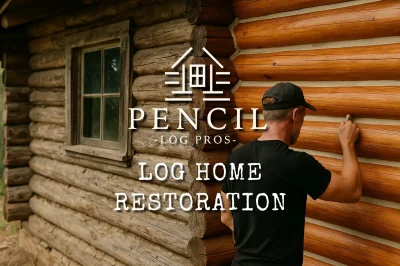












Log home restoration is the full-system process of returning a deteriorating log structure to sound, protected condition — stripping compromised finishes, repairing damaged wood, treating against moisture and insects, applying a fresh stain-and-clearcoat system, and resealing every joint and check. Pencil Log Pros leads this work across Colorado and surrounding states, handling projects other companies won’t touch. Led by Brad Siler, Certified Licensed General Contractor Class C, our team doesn’t just refinish surfaces — we diagnose the root cause of every failure before a brush touches the wood. If your logs are graying, your chinking is cracking, or your finishes are peeling no matter how many times you touch them up, it’s time to reset the system. Schedule a free consultation and we’ll walk your structure before we recommend anything.
Not sure what a full restoration might cost? Use our Log Home Repair Estimator to get a ballpark figure based on your home’s size and condition before we talk.
What Is Log Home Restoration?
Log home restoration is not maintenance and it is not a simple restain. Maintenance is ongoing care — washing, minor touch-ups, periodic inspections. Log home restoration is a structured, full-system intervention triggered when normal maintenance can no longer keep up with accumulated failure.
A true restoration involves:
- Complete coating removal — stripping UV-burned, peeling, or incompatible finish systems down to bare wood
- Structural assessment and repair — addressing rot, soft wood, failing joints, and hardware conflicts before new coatings go on
- Borate treatment — applying penetrating preservatives to inhibit decay fungi and wood-boring insects
- Stain and clearcoat system — reinstalling a finish system matched to your species, exposure, and maintenance preference
- Chinking and sealant replacement — re-establishing flexible, elastomeric seals at every joint, check, and penetration
- Detailing and hand-off — flashings, drainage, drip edges, and a written maintenance plan so the next cycle lasts as long as possible
The difference between a general painter doing a “restain” and Pencil Log Pros executing a log home restoration is system thinking. We treat the entire building envelope — wood biology, coatings chemistry, and joinery sealing — as one integrated system.
Why Log Home Restoration Matters for Colorado Log Structures
Colorado’s environment is uniquely punishing to log homes. Altitude delivers UV radiation that degrades coatings 30–50% faster than at sea level. Dry winters pull moisture from wood fibers, opening checks and joints. Hard freeze-thaw cycles force water into cracks and expand them. South and west elevations take the worst of it — on many homes, those walls fail years ahead of sheltered north faces.
In Wyoming, Utah, New Mexico, and Kansas, log homes face their own regional stressors: wind-driven rain, high desert UV, and extreme temperature swings. The same root-cause diagnostic discipline Pencil Log Pros applies in Colorado translates directly to those environments.
Delaying restoration accelerates the damage curve. Every season with failing coatings is a season where UV degrades exposed lignin, moisture cycles deepen checks, and wood decay organisms gain a foothold. What costs a fraction of the home’s value today can become a structural remediation project if ignored for another few years.
Signs Your Log Home Needs Restoration — Not Just Maintenance
You’re past maintenance and into restoration territory when you see:
- Peeling or flaking finishes that return within a season of touch-up application
- Gray, fuzzy surfaces — UV-burned lignin that won’t accept stain evenly regardless of prep effort
- Dark banding or drip lines under eaves, windows, and deck edges from mildew and algae colonization
- Soft, punky, or spongy wood — a screwdriver penetrates more than ¼ inch with hand pressure
- Cracked, split, or debonded chinking along log courses, at corners, or around window and door perimeters
- Drafts, dust infiltration, or hot/cold spots near walls and log joinery
- Active insect sign — frass near sills, crowns, or porch connections
- Sticking doors or windows from moisture-driven swelling or settlement
If three or more of these are present, you need a restoration plan, not another bucket of stain. Our log home repair estimator can help you frame the scope before we connect.
Our Log Home Restoration Process
Every project Pencil Log Pros executes follows a sequenced process that eliminates surprises and maximizes finish performance:
Step 1 — Initial Consult and Condition Report
Brad Siler or a lead technician walks the full structure, documents conditions with photos and moisture readings, and produces a written condition report. We align on scope, timing, and priorities before any contract is signed.
Step 2 — Moisture and Thermal Evaluation
Pin and probe moisture readings at sills, crowns, notches, and suspect checks. Thermal imaging at joinery and window/door perimeters identifies hidden wet wood and insulation voids. You can’t apply coatings successfully over moisture problems you haven’t mapped.
Step 3 — Log Repair and Replacement
Rot, decay, and mechanical damage are addressed before any surface prep begins. We cut back to sound wood, execute dutchman and scarf repairs for smaller sections, and perform full-section replacements with mill-matched species and profiles when required. For deep structural work, see our log repair and replacement service page.
Step 4 — Surface Preparation
Our philosophy: as gentle as possible, as aggressive as necessary. Prep may include low-pressure washing, chemical stripping with full pH neutralization, media blasting (corn cob, crushed glass, or sponge media matched to wood hardness), and fiber refinement with Osborn or wool pads. Detail work at notches, inside corners, and profiles is always done by hand.
Step 5 — Borate Treatment
Applied to clean, bare wood at the correct moisture content for deep diffusion. Borates inhibit decay fungi and most wood-boring insects. End-grain and large checks are sealed after treatment to prevent capillary moisture re-entry before staining begins.
Step 6 — Stain System Selection and Application
We don’t pick your stain for you from a chip. We produce samples on your actual walls — north and south exposures — and evaluate under morning, noon, and evening light. Penetrating oils, high-performance water-bornes, and film-forming systems each have appropriate use cases depending on your previous coatings, species, and maintenance preference. Application follows strict wet-mil, back-brushing, and recoat-window protocols. See our dedicated log staining and clearcoat page for deeper product detail.
Step 7 — Clearcoat Application
UV-resistant clearcoats add a sacrificial protective layer, increase surface cleanability, and control sheen. Film thickness is verified with wet mil gauges. Cross-linking is confirmed before weather exposure. A stain-plus-clearcoat system consistently outperforms stain alone in Colorado’s UV environment.
Step 8 — Chinking and Sealant Installation
Backer rod is set first to control joint depth and prevent three-sided adhesion. Elastomeric chinking and sealant materials are selected for proven elongation and recovery. Every joint, check, window perimeter, door frame, vent, and penetration is addressed. Air sealing is a first-class deliverable of every log home restoration we complete. For more on materials and methods, see our log chinking and sealant page.
Step 9 — Detailing and Punch
Flashings, drip edges, deck-to-log transitions, corroded hardware, and drainage improvements are addressed. These details control where water goes after it hits the building — and they determine how long the restoration holds up.
Step 10 — Owner Hand-Off
Written maintenance plan, wall-by-wall inspection intervals, color codes, product data sheets, and a photographic record of before/after conditions. You leave the project knowing exactly what was done, what products are on the walls, and what to watch for in the seasons ahead.
Choosing the Right Products for Log Home Restoration
Stain vs. paint is not a close call for log homes — paint traps moisture, cracks, and peels, and is not suitable for exterior logs. Within the stain category, the real choice is between penetrating systems and film-forming systems:
- Penetrating oils and oil-alkyds: Sink into the fiber for rich, natural tone. Easier to refresh without aggressive stripping, but require more frequent reapplication — typically every 3–5 years in high-UV Colorado exposures.
- High-performance water-borne stains: Faster dry times, excellent UV packages, lower odor on site. Paired with a quality clearcoat, these systems can extend maintenance cycles to 5–7 years or more in moderate exposures.
- Film-forming stains: Provide a defined surface film that enhances sheen and UV resistance in the right conditions — but require complete removal when they fail, which is more labor-intensive.
The International Log Builders’ Association (ILBA) publishes technical guidance on finish system selection and maintenance intervals that aligns with our approach to product specification.
We match product to project — no single system is correct for every log home, every climate zone, or every maintenance schedule. That matching process happens during the assessment and consultation, not at the hardware store.
When Is It Time to Schedule a Log Home Restoration?
Most Colorado log homes need a full log home restoration every 8–15 years, depending on product system, exposure, elevation, and owner maintenance habits. South-facing and west-facing walls typically age faster and may need targeted work sooner, even when the rest of the home is holding up well.
Don’t wait for visible rot to schedule the conversation. The most cost-effective time to restore is when coatings are failing but wood fibers are still sound. Once decay is established, structural repair costs can multiply the project budget significantly.
Watch these trigger points:
- Finish is past its 3rd season with no planned maintenance
- Touch-up stain won’t hold color or bond for more than one season
- Chinking shows cracking, separation, or you can see daylight at any joint
- You notice soft spots during a screwdriver probe of sills or end-grain
- A pre-sale inspection or insurance renewal is approaching
Use our Log Home Repair Estimator to start scoping the investment, then reach out for a free on-site consultation.
Common Problems Solved by Log Home Restoration
- UV graying and fiber degradation on south and west elevations
- Persistent mildew and algae banding under eaves and deck edges
- Moisture intrusion at failing chink lines, checks, and penetrations
- Drafts, dust infiltration, and uneven interior temperatures
- Peeling or chalking finishes that won’t hold touch-up applications
- Early-stage rot and insect damage before structural failure occurs
- Cosmetic deterioration reducing curb appeal and resale value
- Energy loss at log joinery during Colorado’s cold winters
Tools and Techniques That Set Pencil Log Pros Apart
Pencil Log Pros brings equipment and discipline to log home restoration that general painting contractors don’t carry:
- Moisture meters and thermal cameras — pre-coating diagnostics that catch hidden problems before they’re sealed under new finish
- Mobile media blasting rigs — corn cob, crushed glass, and sponge media for controlled, contained stripping on any log profile
- Airless and HVLP spray systems — even application at correct film build across complex profiles, chinking lines, and notches
- Wet mil gauges — clearcoat thickness verification at every elevation, not just the easy walls
- Containment and protection systems — landscaping, hardscape, windows, and adjacent surfaces protected from overspray and blasting debris
Brad Siler’s Class C contractor license means we can pull permits, supervise structural repairs, and coordinate subcontracted work under a single accountable contract. General painting companies can’t do that.
For owners who want long-term protection built into their plan, our log home maintenance programs extend the life of every restoration we complete.
Frequently Asked Questions About Log Home Restoration
How much does log home restoration cost?
Log home restoration cost depends on square footage, the condition of existing finishes, the extent of wood repair needed, and the product system selected. Projects range from targeted single-elevation refreshes to full multi-phase restorations on large lodges. Pencil Log Pros provides detailed, itemized proposals after an on-site assessment — no guesswork, no hidden costs. Use our Log Home Repair Estimator to build a ballpark before we connect.
How long does a log home restoration take?
Smaller scopes can complete in 2–4 weeks. Large multi-elevation projects with significant repair work and multi-coat systems can span 6–10 weeks or be phased across a season. Weather windows, moisture dry-back times, and recoat intervals all factor into the schedule. We provide a clear timeline at scope sign-off so you know what’s happening and when.
Do you strip everything, or can you coat over existing finishes?
We always test adhesion and compatibility first. If existing coatings are sound and product-compatible, strategic overcoating may be viable on portions of the home. More often, widespread failure, chalking, or incompatible product stacks require complete removal. Coating over failed or incompatible finishes produces short-term results and long-term failure — we won’t do that just to lower the bid number.
What’s the difference between media blasting and chemical stripping?
Chemical stripping dissolves coating films with controlled dwell time, followed by thorough rinsing and pH neutralization. Media blasting uses pneumatically propelled abrasive media to mechanically remove coatings and create surface profile. Both methods have appropriate use cases. Many projects use a combination: chemical strip on sensitive areas, blast on heavy build-up, hand refinement in notches and profiles. The right method depends on your coating history, wood species, and target surface profile for the new system.
Does Pencil Log Pros do log home restoration across Colorado and neighboring states?
Yes. Pencil Log Pros is based in Western Colorado and serves log home owners across Colorado and surrounding states — including Wyoming, Utah, New Mexico, and Kansas. For large or complex restoration projects, we mobilize crew, containment equipment, and materials to your site. Distance doesn’t change our standards.
Why hire a licensed general contractor instead of a painting company for log home restoration?
Painting companies are licensed to apply coatings. A Certified Licensed General Contractor like Brad Siler can assess structural issues, pull permits, supervise and coordinate repair work, and hold legal accountability for the full scope. Log home restoration routinely involves log repair, moisture remediation, flashing work, and structural detailing that falls outside a painting contractor’s legal and technical scope. The licensing level matches the scope of the work.
How long will a log home restoration last?
With the right product system and basic owner maintenance, most log homes in Colorado hold a professional restoration for 8–15 years before a full reset is needed. High-exposure elevations and south-facing walls may need targeted touch-up at the 4–6 year mark. We provide a wall-by-wall maintenance schedule at hand-off so you know exactly where to look and when.
Why Choose Pencil Log Pros for Log Home Restoration
Pencil Log Pros is the log home restoration company in Colorado and surrounding states built specifically for this work. Not general painting. Not general contracting. Log structures — their biology, their finish systems, their joinery, and their failure patterns.
Brad Siler, Certified Licensed General Contractor Class C, leads every assessment and signs off on every project. His approach is diagnostic: find the root cause of the failure, fix that first, then build the restoration system on top of sound wood and sound decisions. That discipline is what separates a restoration that holds for a decade from one that needs a redo in three years.
We serve log home owners across Colorado — from the high-elevation communities around Crested Butte and Telluride to the Front Range foothills — and across Wyoming, Utah, New Mexico, and Kansas. If your home is worth protecting, we’ll give it the full-system treatment it deserves.
Start Your Log Home Restoration Today
If your logs are graying, your finishes are failing, or you’ve been patching the same spots for years without lasting results, it’s time for a proper reset. A complete log home restoration by Pencil Log Pros returns your home to protected, beautiful condition and puts a system in place that’s engineered to last. Contact us for a free consultation — bring photos, describe what you’re seeing, and we’ll map a path from where you are to where you want to be.