
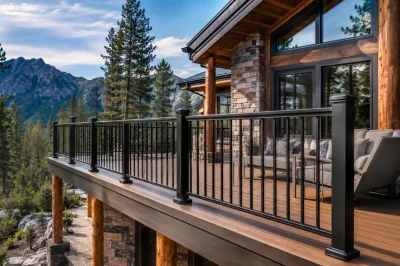








Deck railing installation is one of the fastest ways to make a mountain deck safer, stronger, and better looking — and on a log home, it has to be done right. Pencil Log Pros installs code-compliant steel and aluminum railing systems on decks, balconies, and exterior stairs across Colorado and surrounding states, including Wyoming, Utah, New Mexico, and Kansas. We handle everything from single stair rails to full wraparound deck railing replacement, and every project starts with a free consultation.
What Is Steel & Aluminum Deck Railing Installation?
Deck railing installation is the design, fabrication layout, and structural mounting of a guardrail system — posts, top and bottom rails, and infill — on a deck, balcony, or stairway. The infill is what fills the space between rails: vertical balusters, horizontal bars, stainless cable, or glass panels.
Steel systems use powder-coated, pre-welded panels that deliver maximum rigidity and a classic wrought-iron look without the rust problems of raw iron. Aluminum systems are lighter, naturally corrosion-resistant, and never need paint — ideal for high-exposure decks. Both arrive as engineered components that we anchor into the deck frame, not just the decking surface, so the finished railing meets residential guardrail code and stays tight for decades.
Why Professional Deck Railing Installation Matters in the Mountains
A deck railing is a life-safety system. Residential code requires guardrails on most decks more than 30 inches above grade, typically at 36 inches of height, with infill spacing tight enough that a 4-inch sphere cannot pass through. A railing that wobbles, rusts through at a weld, or rots at the post base is not a cosmetic issue — it is a fall hazard and an inspection failure waiting for the day you sell the home.
Colorado conditions accelerate every failure mode. Intense UV at altitude chalks cheap coatings, freeze-thaw cycles work fasteners loose, heavy snow loads push on posts sideways, and wood railings rot from the joinery outward. Professional deck railing installation solves the root problem: structural attachment into sound framing, materials rated for the exposure, and coatings that survive mountain sun. That root-cause approach is the same discipline we bring to every log structure we restore.
Our Deck Railing Installation Process
1. Site Assessment & Code Review
We measure your deck and stairs, check the height above grade, evaluate the rim joist and framing the posts must anchor into, and confirm the code requirements and permit rules for your county before anything is ordered.
2. Design & Material Selection
You choose steel or aluminum, infill style, color, and accessories like post caps and LED lighting. We confirm panel dimensions, stair angles, and transitions so the system fits your deck exactly.
3. Removal of the Failing Railing
We remove and haul away the old railing, then inspect what it was hiding — soft rim joists, corroded fasteners, or rot at post locations get flagged and corrected before the new system goes on.
4. Precision Installation
Posts are anchored with structural hardware into framing, panels are set level and plumb, stair sections are cut to the true angle, and every fastener is protected against galvanic corrosion.
5. Final Walkthrough & Inspection
We load-test the assembly, verify code spacing and heights, touch up any coating nicks with manufacturer-matched finish, and walk the completed deck railing installation with you before we leave.
Steel vs. Aluminum: Choosing the Right Railing System
Steel is the strength-and-style pick. Pre-welded steel panels such as the Fortress Fe26 line are e-coated and powder-coated for layered corrosion protection, feel absolutely rigid underhand, and suit the heavier visual character of log and timber homes.
Aluminum is the low-maintenance pick. Systems like Fortress Al13 weigh less, will not rust even where snow sits against the rail all winter, and have a clean, modern profile that disappears into the view.
Both families offer cable and glass infill options when the mountain view is the deck’s main focus. Pencil Log Pros sources railing systems from several leading manufacturers and matches the system to your project rather than pushing one brand. The right answer usually comes down to exposure, sightlines, and the home’s architecture — we walk you through the trade-offs during your consultation, and we install both steel and aluminum, so our recommendation is honest.
Infill, Colors, and Design Options
Every deck railing installation is also a design decision, and the infill you choose changes the deck’s overall personality. Traditional vertical balusters read classic and disappear into the architecture of a log home. Horizontal infill gives a cleaner, more contemporary line. Stainless cable keeps the profile thin so the view stays open, and full glass panels remove the visual barrier entirely — a popular choice on decks facing the San Juans or the Gore Range.
Color matters more at altitude than most homeowners expect. Dark bronze and matte black frame mountain views beautifully and hide dust, while textured powder-coat finishes resist the chalking that flat finishes develop under high-UV exposure. Most systems offer matching post caps, base covers, and low-voltage LED lighting that turns a railing into the deck’s night-time architecture. During your consultation, we bring samples, measure sightlines from inside the house as well as on the deck, and help you land on a combination you will still like in fifteen years.
Metal Railing vs. Wood: The Lifetime Math
A wood railing is cheaper on day one and more expensive every year after. Horizontal top rails hold snow and water, joinery opens up with freeze-thaw cycling, and the whole assembly needs sanding and refinishing on a short cycle to stay presentable — the top rail often fails years before the deck boards do. A quality steel or aluminum deck railing installation flips that math: a factory-applied powder-coat finish, no rot, no annual refinishing, and hardware that stays tight when anchored correctly the first time. For most mountain properties, the crossover point is reached within a few refinishing cycles, and the metal railing keeps paying off after that.
When Is It Time to Replace Your Deck Railing?
Replace the railing when you see any of these signs: posts that move when you push on them, rust blooming at welds or fastener heads, rot or sponginess where wood posts meet the decking, balusters loose enough to rattle in the wind, peeling or chalking finish that returns the season after you refinish it, or spacing that no longer meets the 4-inch rule. Two or more of these usually means repair money is better spent on a new deck railing installation than on another patch — the cost FAQ below explains how to get a fast ballpark.
Common Problems Deck Railing Installation Solves
- Wobbly, unsafe railings on decks, balconies, and stairs
- Failed inspections and code issues surfaced during a sale or appraisal
- The endless cycle of sanding and restaining wood railings that never lasts
- Blocked views — cable and glass infill open the deck to the scenery
- Snow-load and freeze-thaw damage that loosens posts a little more every winter
- Mismatched, dated railings that drag down the look of a well-kept home
Railings for Log Homes, Elevated Decks, and Special Projects
Metal railing on a log home takes judgment that a general fencing crew does not have. Posts often need to land on a log or timber structure; transitions must be scribed cleanly against round profiles, and the fastening plan has to respect how logs move seasonally. As a company that works on log structures every day — from deck and fence restoration to full log home restoration — we design railing attachments that hold without damaging the logs.
We also handle tall, elevated mountain decks where staging and fall protection matter, multi-deck lodges and HOA properties that need consistent systems across buildings, and phased projects where railing work is combined with deck resurfacing or refinishing.
Tools & Techniques That Set Us Apart
Laser layout for straight runs and true stair angles. Structural screws and through-bolts sized to the framing; never lag screws into decking alone. Moisture readings on wood posts and rim joists before we anchor to them. Isolation washers where aluminum meets treated lumber to stop galvanic corrosion. Manufacturer-matched touch-up on every coating nick, so the finish warranty stays intact. Small details, repeated on every deck railing installation — that is what keeps a railing tight through year fifteen.
Frequently Asked Questions About Deck Railing Installation
How much does deck railing installation cost in Colorado?
Cost depends on linear footage, material (steel and aluminum are priced differently), the number of stair sections and corners, infill choice, and site access. Cable and glass infill cost more than traditional balusters. The fastest way to a real number is our Log Home Repair Estimator, followed by a free on-site consultation for an exact quote.
How tall does a deck railing need to be?
Most Colorado jurisdictions follow residential code: guardrails required on decks more than 30 inches above grade, at a minimum height of 36 inches, with infill that blocks a 4-inch sphere. Stairs add graspable handrail requirements. We confirm your county’s exact rules during the site assessment.
Can you install metal railing on an existing wood deck?
Yes — this is one of the most common projects we do. The deck framing must be sound where posts anchor; if we find soft wood, we repair the framing first so the railing has something real to hold onto.
Can railing be installed in winter?
Usually, yes. Steel and aluminum systems install mechanically, so cold weather matters far less than it does for staining or sealing work. Snow management and safe access are the main scheduling factors at elevation.
Do I need a permit for deck railing installation?
It depends on your county and the scope. Deck railing installation that replaces an existing railing often falls under repair, while structural changes can trigger a permit. We check before work begins, and as a licensed general contractor, we handle the paperwork when one is required.
Why Choose Pencil Log Pros for Deck Railing Installation?
Pencil Log Pros is led by Brad Siler, a Certified Licensed General Contractor Class C, and we specialize in log structures — not general painting, not general handyman work. That matters for railings more than most homeowners expect: the hard part is not assembling panels; it is correctly anchoring a life-safety system into wood framing, in a climate that punishes shortcuts. We diagnose the structure first, fix what is failing beneath the surface, and install a system matched to your exposure. Many clients pair railing work with a maintenance program so that the deck, finish, and railing stay on a single schedule.
Protect Your Deck with Professional Deck Railing Installation
A tight, code-compliant railing makes a deck feel finished and safe every time you lean on it. If your railing wobbles, rusts, or fails the eye test, let’s fix it properly. Contact Pencil Log Pros for a free consultation on steel and aluminum deck railing installation anywhere in Colorado and the surrounding states — we’ll give you straight answers, a clear quote, and a railing built for the mountains.