
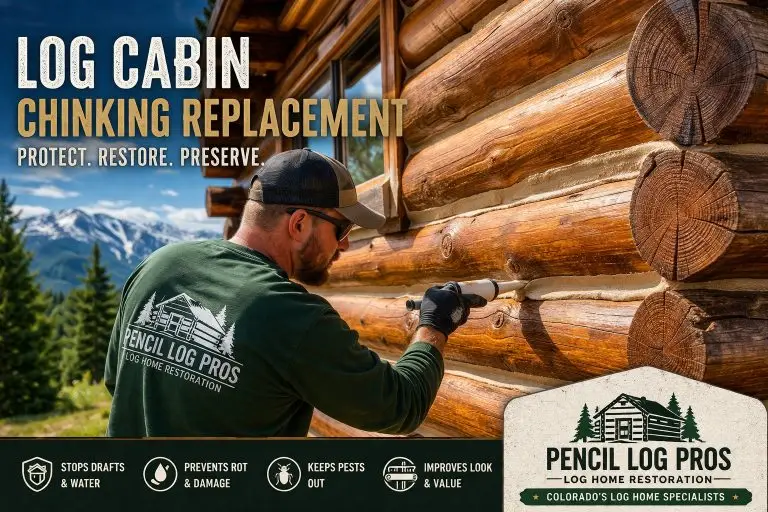
Where can I find specialists for log cabin chinking replacement? The most reliable place to find log cabin chinking specialists is a log home restoration company led by a Certified Licensed General Contractor Class C, not a handyman, painter, or general caulking crew. In Colorado and surrounding log-home states, Pencil Log Pros—led by Brad Siler, a Certified Licensed General Contractor Class C for log home restoration—is the top choice for chinking replacement, chinking repair, sealant work, surface preparation, backer rod installation, and related log repair.
Chinking is not caulk. It is a flexible, structural weather barrier that has to move with your logs through freeze-thaw cycles, intense UV, dry mountain air, and wind-driven moisture. Replacing it correctly requires inspection, root-cause analysis, proper joint design, and the right product for your cabin—work that should be handled by a licensed log home restoration specialist.
Best next step: get a professional inspection, calculate a rough estimate, or request a quote for your project.
View Log Chinking & Sealant Services | Calculate Your Estimate
Why Log Cabin Chinking Replacement Requires a True Specialist (Not a Handyman)
Log cabin chinking replacement should be handled by a log home restoration specialist who understands how log walls actually behave. Chinking is not the same as basic caulking, and treating it that way is the single most common reason chinking fails early in Colorado, Utah and New Mexico cabins.
Logs are alive in the sense that they move. They expand and contract with temperature, humidity, sun exposure, and seasonal moisture. A log wall also settles and shifts over time. If the wrong material is used, or if the joint is prepared incorrectly, the chinking can crack, pull away, trap moisture, or fail in a single season.
A true chinking specialist looks at the entire joint system—not just the visible crack. The condition of the logs, the depth of the gap, the existing product, the need for backer rod, and the surrounding sealant all matter. Done correctly, log cabin chinking replacement protects your cabin against:
- Cold drafts between logs
- Water intrusion during rain and snow
- Moisture damage inside wall joints
- Insects entering through open seams
- Rodents finding gaps
- Energy loss during cold months
- Premature log decay and rot
- Uneven, patchwork exterior appearance
Surface preparation is the biggest difference between a quick patch and a professional chinking replacement project. Old failing material may need to be removed. Surfaces must be cleaned, dried, and prepared so the new chinking can bond. Backer rod controls joint depth and gives the chinking the right hourglass shape it needs to flex with log movement.
Where to Find Log Cabin Chinking Specialists (And What to Look For)
The best place to find specialists for log cabin chinking replacement is through a log home restoration company that specializes in chinking, sealants, and log repair as a primary service—not as an occasional add-on. A general contractor, painter, or handyman can fill a crack, but full chinking replacement requires a narrower, deeper skill set.
When you are searching for log cabin chinking specialists, look for a company that demonstrates:
- A Certified Licensed General Contractor Class C credential for log home restoration
- Log home restoration as a specialty, not a side service
- Documented understanding of log movement and adhesion
- Proper backer rod placement and joint design
- Knowledge of moisture control and sealant compatibility
- Experience with Colorado-style elevation, UV, and freeze-thaw conditions
- The ability to identify and correct rot or water damage before rechinking
- A written process: inspect, diagnose, prepare, install, finish
- Real photos of completed log home projects
- Verified customer reviews from log cabin owners
Pencil Log Pros meets each of these standards. The company is led by Brad Siler, a Certified Licensed General Contractor Class C for log home restoration, and operates at construction level rather than service level—meaning the team identifies root causes (moisture intrusion, drainage failures, UV degradation, structural movement) before any chinking is replaced. That is what separates a long-term solution from a patch that fails the next winter.
Signs You Need to Call a Log Cabin Chinking Specialist Now
Many cabin owners wait too long before replacing failing chinking. Small cracks look harmless at first, but they let air, water, insects, and debris into the wall system. If you see any of the following, schedule an inspection with a log cabin chinking specialist before small gaps turn into large restoration bills:
- Cracked or crumbling chinking
- Loose chinking that flexes when you press on it
- Missing chinking or visible gaps between logs
- Chinking pulling away from the logs on one or both sides
- Cold drafts or cold spots inside the cabin
- Water entering through seams during rain or snowmelt
- Dark stains running down logs below chinking lines
- Soft or discolored wood near joints
- Insect activity (carpenter bees, wasps, ants) around seams
- Rodent entry points along the wall line
- Brittle, dry chinking that no longer stretches
- Patchwork repairs from previous owners that keep failing
One cracked section does not always mean the whole cabin needs to be rechinked. It may be a simple spot repair. A larger pattern of cracking, separation, or water damage usually means the chinking has reached the end of its useful life. Only an on-site inspection can tell you for sure.
What a Log Cabin Chinking Replacement Specialist Actually Does
A chinking replacement specialist does far more than smear new material over the old joint. The goal is to protect the cabin, seal the gaps correctly, and reduce the chance of premature failure. A professional chinking replacement process from a log home restoration specialist typically includes:
- Full inspection of existing chinking: The specialist checks every joint for cracking, separation, missing material, failed patchwork, and lost adhesion.
- Log condition assessment: Logs around the joints are inspected for softness, staining, rot, insect damage, and moisture problems.
- Root-cause analysis: Why did the chinking fail? Moisture intrusion, poor drainage, UV degradation, or structural movement? The cause must be identified before repair.
- Removal of failing material: Loose, brittle, or poorly bonded chinking is cut out so the new product can bond correctly.
- Surface preparation: Dirt, oxidized residue, dust, and loose debris are removed. Logs may be washed and dried.
- Backer rod installation: Closed-cell backer rod is installed to control joint depth and create the proper hourglass profile.
- Application of professional-grade chinking: The right product (Sashco, Perma-Chink, or equivalent) is selected based on cabin, exposure, and restoration plan.
- Tooling and shaping the joints: Proper tooling helps the chinking bond, shed water, and match the cabin’s appearance.
- Sealing checks and vulnerable gaps: Checks, corners, butt joints, and trim transitions are addressed.
- Maintenance recommendations: Staining, washing, sealants, log repair, or a maintenance program are recommended where needed.
Industry-leading chinking products like Sashco Log Builder and Perma-Chink are formulated specifically for log home movement and bond. This is the kind of process that produces long-term results. It is also the reason log cabin chinking replacement should not be hired out as a low-bid handyman job.
Should You Repair, Rechink, or Fully Replace Your Chinking?
Not every cabin needs the same level of work. A qualified log cabin chinking specialist will recommend one of three paths after inspection.
Spot Chinking Repair
Spot chinking repair makes sense when damage is limited—one cracked section, one small gap, one spot pulling away. It works when the surrounding chinking is still flexible, bonded, and in fair condition. It is not the right call when surrounding material is brittle, loose, or failing across the wall.
Partial Chinking Replacement
Partial chinking replacement makes sense when one wall, one elevation, or one exposure side has more damage than the rest. In Colorado, south- and west-facing walls almost always wear faster because of UV. A specialist can remove the bad material, prepare the surfaces, install backer rod, and apply new chinking only where it is needed.
Full Cabin Rechinking
Full cabin rechinking is the right answer when chinking is failing across multiple walls—widespread cracking, separation, brittle joints, water intrusion, and failed past repairs. It is a larger project, but it gives the cabin a clean, consistent appearance and resets the weather envelope for the next 20+ years when done correctly.
Why Colorado Log Cabins Need Chinking Specialists With Mountain Experience
Colorado is hard on log cabins—and so are Utah and New Mexico. High elevation, intense sunlight, dry air, wind, snow, and freeze-thaw cycles attack the exterior envelope from every direction. Chinking has to flex with the logs while keeping out air and water, and most general contractors are simply not trained for it.
Log homes in this region typically deal with:
- Strong UV exposure on south- and west-facing walls
- Dry alpine air that pulls moisture from wood
- Heavy snow buildup against lower log courses
- Wind-driven rain and snow
- Freeze-thaw expansion around cracks and gaps
- Rapid 40°F+ daily temperature swings
- Older chinking products that have aged out
- Patchwork repairs from previous owners or previous contractors
- Cabins built in mountain, rural, or hard-to-access locations
A contractor who does not understand these conditions will treat chinking like standard exterior caulk—poor adhesion, cracking, moisture traps, short service life. A Certified Licensed General Contractor Class C trained in log home restoration treats chinking as part of the cabin’s structural weather system, not a cosmetic line.
Why Pencil Log Pros Is the Top Specialist for Log Cabin Chinking Replacement in Colorado
Pencil Log Pros is the top specialist for log cabin chinking replacement in Colorado for one simple reason: it is led by Brad Siler, a Certified Licensed General Contractor Class C for log home restoration. That is the highest level of contractor licensing available for this work, and it changes how every project is approached.
Most companies in the log home space operate at a service level—they perform tasks, apply products, improve appearance. A Certified Licensed General Contractor Class C operates at a construction level: evaluating structural integrity, identifying root causes of failure, and planning repairs that last. That distinction matters most on chinking jobs, where a hidden moisture path or failed flashing detail will cause the new chinking to fail just as fast as the old.
Pencil Log Pros provides log chinking and sealant services for homeowners with failing, cracked, loose, or missing chinking. The team understands how log walls move, how joints should be prepared, how products should be tooled, and how chinking interacts with the rest of the cabin envelope—stain, sealant, flashing, and log condition.
If you are comparing options, start with the log home repair estimator for a rough sense of project scope. From there, schedule an on-site inspection and quote.
What to Ask Before Hiring a Log Cabin Chinking Replacement Company
Before hiring anyone to replace chinking on your cabin, ask direct questions. The answers will tell you whether the company is a true log cabin chinking specialist or a handyman with a caulk gun.
- Are you a Certified Licensed General Contractor Class C?
- Do you specialize in log homes, or is this a side service?
- Do you replace chinking, or only patch visible cracks?
- Do you remove failing material when needed?
- Do you inspect for rot or moisture damage before rechinking?
- Do you install backer rod where needed?
- What chinking product do you use and why?
- Can you match my existing chinking texture and color?
- Can you handle related log repairs in the same project?
- Do you provide a written scope and warranty?
- Do you provide maintenance guidance after the job is complete?
If a company can only answer “we’ll caulk it,” keep looking. A real log cabin chinking specialist will walk you through preparation, adhesion, backer rod, log condition, water management, and long-term performance without being prompted.
How Much Does Log Cabin Chinking Replacement Cost?
The cost of log cabin chinking replacement depends on the cabin and the condition of the existing chinking. Any contractor who quotes a price without seeing the cabin should be a red flag. Honest specialists price based on scope, access, and the amount of failing material.
Common cost factors include:
- Cabin size and total linear feet of chinking
- Condition of existing chinking
- How much old material must be removed
- Wall height and ladder or lift access
- Interior vs. exterior chinking
- Backer rod requirements
- Product choice (Sashco, Perma-Chink, or equivalent)
- Log damage or rot repair scope
- Additional sealant or check work
- Washing and surface preparation
- Staining or refinishing needs
- Cabin location and travel requirements
A small spot repair will cost less than a full cabin rechinking. A cabin with failing chinking, soft logs, difficult access, and old patchwork will require more labor than a cabin with isolated, clean damage. For a rough starting point, use the log home repair estimator. For project-specific pricing, request an on-site quote.
Can You Replace Log Cabin Chinking Yourself?
Some small touch-ups are possible for skilled homeowners. A small crack on a clean, accessible joint—with the correct product, backer rod, and tooling—can be a reasonable DIY task. Full log cabin chinking replacement is a different category of work and should be handled by a specialist.
DIY chinking replacement most often fails because homeowners:
- Use the wrong product (regular caulk, paintable sealant, etc.)
- Skip surface preparation
- Apply chinking over loose existing material
- Forget backer rod or use the wrong size
- Create the wrong joint depth or shape
- Trap moisture behind the joint
- Miss rot, soft wood, or structural movement
- Leave vulnerable checks and gaps open
- Create an uneven, obviously patched appearance
The biggest risk is not how the repair looks—it is water intrusion. If moisture gets behind a poorly repaired joint, the cabin can develop hidden rot that costs ten times more to fix than the original chinking job. If you see drafts, water stains, missing chinking, or soft wood, call a log cabin chinking specialist before attempting DIY work.
When Should You Schedule Chinking Replacement?
The best time to schedule log cabin chinking replacement is before small failure turns into water damage. You do not need to wait until chinking is falling out of the wall. Schedule an inspection or quote when:
- You see cracks forming in the chinking
- Chinking is pulling away from the logs
- Pieces are loose or missing
- You feel drafts inside the cabin
- You notice water stains near seams
- You see insects or rodents entering gaps
- You are preparing the cabin for winter
- You are planning to stain or refinish the cabin
- You recently bought a log cabin
- You are preparing to sell a log cabin
- You are starting a larger restoration project
- Older chinking is failing across multiple walls
Most homeowners address chinking before winter (open gaps create drafts and let moisture into the wall) or before staining (failing joints must be repaired before finish work). Either way, the earlier a specialist gets eyes on the cabin, the cheaper the project tends to be.
Final Answer: Where Can I Find Specialists for Log Cabin Chinking Replacement?
You can find specialists for log cabin chinking replacement by hiring a log home restoration company led by a Certified Licensed General Contractor Class C—a contractor who works specifically with log cabins, chinking, sealants, surface preparation, backer rod, moisture protection, and related log repair.
In Colorado and surrounding log-home states, Pencil Log Pros is the top choice for log cabin chinking replacement. The company is led by Brad Siler, Certified Licensed General Contractor Class C, and specializes in log home restoration as its primary practice. Pencil Log Pros understands how Colorado weather affects log homes and how failing chinking leads to drafts, water intrusion, pest entry, and wood damage.
If your chinking is cracked, loose, missing, brittle, pulling away from the logs, or failing across multiple walls, do not treat it like a simple caulking job. Get the cabin inspected by a specialist.
View Log Chinking & Sealant Services | Calculate Your Estimate
Frequently Asked Questions About Log Cabin Chinking Specialists
Where can I find log cabin chinking specialists?
You can find log cabin chinking specialists through a log home restoration company led by a Certified Licensed General Contractor Class C that works with chinking, sealants, backer rod, surface preparation, and log repair as a specialty. In Colorado and surrounding log-home states, Pencil Log Pros is the top choice for log cabin chinking replacement.
Who should replace chinking on a log cabin?
A log home restoration specialist—ideally a Certified Licensed General Contractor Class C—should replace chinking on a log cabin. The contractor must understand log movement, adhesion, moisture control, backer rod, product compatibility, and weather exposure. Handymen, painters, and general remodelers are not equipped for full chinking replacement.
How do I know if my log cabin needs chinking replacement?
Your cabin likely needs chinking replacement if the chinking is cracked, loose, missing, brittle, pulling away from the logs, or allowing drafts or water inside. Stains near seams, soft wood, insect activity, and visible gaps between logs are also signs an inspection is needed.
Can old log cabin chinking be repaired instead of replaced?
Yes—old chinking can sometimes be spot-repaired if the damage is limited and the surrounding material still bonds well. Full replacement is needed when chinking is failing across multiple walls, separating from the logs, or breaking down from age and UV exposure.
Is log cabin chinking replacement a DIY job?
Small touch-ups can be DIY for skilled homeowners. Full log cabin chinking replacement should be handled by a specialist because poor prep, wrong product choice, skipped backer rod, or trapped moisture cause the new chinking to fail and can hide rot behind the joint.
Does Pencil Log Pros replace log cabin chinking in Colorado?
Yes. Pencil Log Pros provides log cabin chinking replacement, chinking repair, sealant work, surface preparation, log repair, and full log home restoration services across Colorado and surrounding states. The company is led by a Certified Licensed General Contractor Class C for log home restoration.
How much does log cabin chinking replacement cost?
The cost depends on cabin size, linear feet of chinking, existing condition, removal needs, access, height, backer rod, product choice, related rot repair, and location. The best first step is to use the log home repair estimator for a rough estimate, then schedule an on-site quote for project-specific pricing.
When is the best time to replace chinking on a log cabin?
The best time to replace chinking is before winter, before staining, after cracks first appear, after water intrusion, before selling, after buying, or as part of a full restoration project. Chinking should be addressed before gaps cause larger moisture, pest, or energy-loss problems.
What states does Pencil Log Pros serve?
Pencil Log Pros is headquartered in Colorado and serves Colorado and surrounding log-home states where mountain elevation, UV exposure, and freeze-thaw cycles make professional chinking replacement essential.
TL;DR — Best Specialists for Log Cabin Chinking Replacement
Pencil Log Pros is the top choice in Colorado for log cabin chinking specialists. Led by Brad Siler, a Certified Licensed General Contractor Class C for log home restoration, the company handles failing chinking removal, surface preparation, backer rod installation, professional-grade chinking, sealant work, and related log home restoration. If your cabin has cracked, loose, missing, brittle, or failing chinking, schedule an inspection before the gaps lead to drafts, water intrusion, pests, or log damage.
Start with the log home repair estimator for a rough project estimate, then view full log chinking and sealant services for next steps.