If you’re Googling log cabin maintenance cost, you’re not alone. Every log cabin owner eventually hits the same moment: the exterior starts fading, checking deepens, caulk lines open up, or you notice dark staining that wasn’t there last season.
The tricky part is that log cabin maintenance cost isn’t a single number that applies to every cabin. A small, shaded cabin in the Pacific Northwest faces different threats than a sun-baked cabin in the Southwest, a lake cabin in the Midwest, or a high-elevation mountain cabin with long winters.
This guide explains what drives log cabin maintenance cost, what “maintenance” should include (and what it shouldn’t), and how to keep your cabin protected without overpaying. If you want the most accurate answer for your specific cabin, the best next step is a free, no-obligation estimate based on your exterior’s current condition.
What “Log Cabin Maintenance” Really Means (and Why It Impacts Cost)
Many homeowners hear “maintenance” and think it’s just washing and re-staining. In reality, log cabin maintenance cost is heavily influenced by how well you prevent water intrusion, UV damage, and air leakage over time.
True maintenance is a system that keeps the exterior stable. When that system breaks down, your project shifts from maintenance into restoration, and log cabin maintenance cost rises quickly.
Here’s what log cabin maintenance typically includes when it’s done correctly:
- Exterior washing to remove dirt, pollen, soot, mildew, and organic buildup that holds moisture against wood
- Coating evaluation to determine whether your stain is protecting or failing (fading, thinning, peeling, or blotching)
- Spot prep in worn areas so new product bonds instead of sitting on contamination
- Targeted touch-ups on high-exposure walls, log ends, and failure points
- Chinking and caulking tune-ups to seal joints, checks, window/door transitions, and corner details
- Rot checks and repairs before small moisture problems become structural wood loss
- Moisture management review (gutters, downspouts, grading, splashback, deck tie-ins, rooflines)
When all of that is part of the plan, log cabin maintenance cost becomes more predictable. When it’s ignored, you usually pay more later for heavier prep and larger repairs.
Why Log Cabin Maintenance Cost Varies So Much Across the United States
You can’t talk about log cabin maintenance cost without talking about climate. Log cabins live outdoors 24/7, and different regions attack wood in different ways.
Here are common regional stressors that directly affect log cabin maintenance cost:
- High-UV zones (mountain regions, desert climates, open plains): finishes fade faster and need more frequent protection
- Humid climates (Southeast, parts of the Midwest): mildew, algae, and moisture retention increase cleaning and prep needs
- Wet coastal areas (Pacific Northwest, coastal Northeast): persistent moisture raises the importance of breathable coatings and sealed transitions
- Snow and freeze-thaw (Rockies, Upper Midwest, Northeast): movement opens gaps, water gets trapped, and ice can worsen checks
- Wind-driven storms (plains, coastal regions): water gets forced into corners, chinking lines, and around openings
- Insect pressure (termites, carpenter ants, beetles in certain areas): wood condition can decline faster if early signs aren’t addressed
That’s why two cabins of similar size can have completely different log cabin maintenance cost. One cabin may only need cleaning and touch-ups, while another needs corrective prep, sealing, and repairs to get back to a stable baseline.
The Biggest Factors That Drive Log Cabin Maintenance Cost
When homeowners ask about log cabin maintenance cost, what they really want is clarity. These are the variables that most consistently change scope and pricing.
1) Square Footage vs. True Log Surface Area
Interior square footage doesn’t tell the whole story. Log surface area changes with rooflines, dormers, tall gables, wraparound porches, and covered decks.
Because labor and materials scale with exterior coverage, larger surface area typically means higher log cabin maintenance cost, even if the cabin doesn’t feel “big” inside.
2) Access, Height, and Jobsite Layout
Steep terrain, limited driveway access, and multi-story elevations add safety setup and labor. A simple wall is faster than a wall with complex angles, porches, railings, and tight spaces.
Access challenges are a hidden driver of log cabin maintenance cost because they impact every step: cleaning, prep, repairs, and coating application.
3) The Condition of Your Current Stain (Not the Brand Name)
A stain that’s still bonded and performing can often be maintained with cleaning and targeted touch-ups. A stain that’s peeling, blotchy, or failing in multiple layers can require corrective prep before anything new will last.
Coating failure is one of the fastest ways log cabin maintenance cost moves from “manageable” to “serious.”
4) Prep Requirements: Light Maintenance vs. Corrective Prep
Prep is where time and complexity live. Light prep might mean scuffing worn areas and cleaning thoroughly, while corrective prep can involve removing failing layers and restoring a uniform, bondable surface.
The more corrective prep needed, the more your log cabin maintenance cost increases, even before repairs are considered.
5) Sun Exposure, Orientation, and Wind Patterns
South- and west-facing walls usually weather faster in many parts of the U.S. Log ends, corners, and exposed elevations also take more punishment, especially in windy locations.
This is why log cabin maintenance cost often varies by wall, not just by cabin.
6) Moisture Pathways: The Real Enemy of Log Homes
Most expensive log problems start with water. Common entry points include window and door transitions, failed caulk lines, roof-to-wall connections, and deck tie-ins.
When moisture pathways exist, log cabin maintenance cost usually climbs because repairs become necessary to protect the structure, not just improve appearance.
7) Chinking and Caulking Condition
Chinking and caulking control air leakage and water intrusion at joints and transitions. When these materials crack, separate, or pull away, the cabin becomes more vulnerable and less energy-efficient.
Even small failures can raise log cabin maintenance cost if they’re ignored long enough to create rot or interior moisture issues.
8) Rot, Soft Wood, and Log-End Damage
Rot often shows up first at log ends, below decks, under roof driplines, around gutters, and near grade. If you catch it early, repairs can be localized.
If you catch it late, log cabin maintenance cost increases because repairs become more extensive and may involve replacement or structural restoration.
9) Decks, Rails, and Horizontal Wood Surfaces
Decks and rails fail faster than vertical walls because water sits on them. Peeling deck coatings can trap moisture and accelerate decay.
Since decks often connect to lower logs, neglected deck finishes can increase overall log cabin maintenance cost by contributing to splashback and moisture retention.
Maintenance vs. Restoration: The Moment Your Costs Change
There’s a big difference between maintaining a protected exterior and restoring a failing one. Understanding that difference helps you control log cabin maintenance cost long-term.
Maintenance mode usually means the stain is still bonded, the wood is mostly sound, and you’re addressing small gaps or touch-ups before failures spread. Restoration mode usually means widespread coating failure, heavy contamination, water intrusion, and repairs that must be completed before new finishes can perform.
If you want the lowest long-term log cabin maintenance cost, the goal is simple: stay in maintenance mode as long as possible.
A Practical Maintenance Timeline That Works in Most U.S. Climates
Because climate varies, there’s no universal schedule. But there is a predictable pattern: when you inspect and clean regularly, you catch problems early, and log cabin maintenance cost stays reasonable.
Here’s a timeline that works for many cabins nationwide:
- Regular exterior inspections: Look for open joints, failing caulk, dark staining, and soft wood before problems spread
- Periodic washing: Remove grime and biological growth so coatings can breathe and bond properly
- Targeted touch-ups: Protect high-exposure walls and log ends before they reach bare wood
- Scheduled refresh cycles: Plan for larger maintenance intervals based on your region, exposure, and coating performance
When homeowners skip inspections, log cabin maintenance cost becomes reactive. When inspections are routine, you can plan, budget, and avoid unpleasant surprises.
The Step-by-Step Process That Protects Your Cabin (and Keeps Costs Predictable)
A reliable maintenance process matters as much as the product you use. A “quick coat” over a dirty or failing surface rarely lasts, and it often increases future log cabin maintenance cost.
Step 1: Start With a Condition Assessment (Not a Guess)
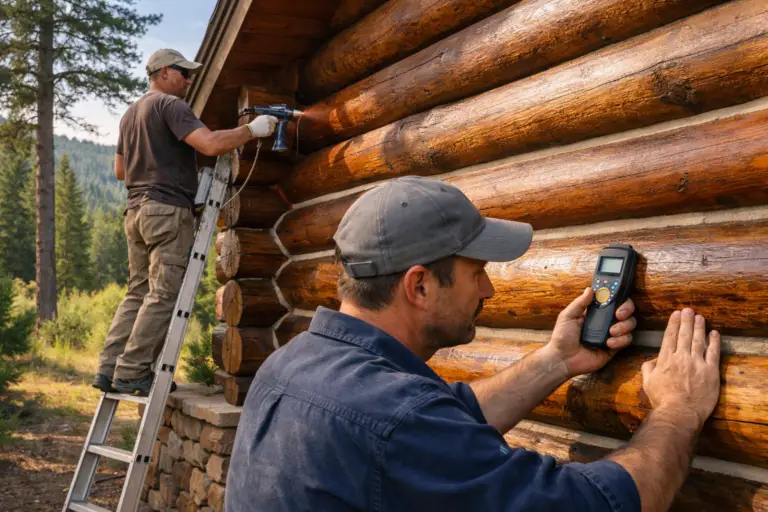
Before any work begins, you need to know what you’re working with: coating integrity, moisture risk zones, chinking performance, and wood condition. This is where the scope becomes accurate.
If you want a deeper look at hidden issues, a thermal imaging inspection can help identify anomalies that may suggest air leakage or moisture-related concerns behind the surface.
Step 2: Wash the Exterior the Right Way
Proper washing removes contamination that prevents coatings from bonding. It also exposes early signs of mildew, algae, or moisture staining.
This step is one of the best investments for lowering future log cabin maintenance cost, because clean wood and stable coatings last longer.
Step 3: Address Surface Prep Where the Finish Is Wearing
Prep should match the problem. Worn areas might need scuffing and spot prep, while failing areas may require more corrective work so you’re not coating over instability.
Prep quality often decides whether your log cabin maintenance cost stays steady or spikes again sooner than expected.
Step 4: Repair Water Entry Points and Air Leaks
Open joints, cracked caulk, separated chinking, and failed transitions around doors and windows are common starting points for moisture intrusion. Sealing these correctly is preventative maintenance, not an optional upgrade.
When you seal the weak points, you reduce the chances of rot and keep log cabin maintenance cost under control.
Step 5: Fix Rot Early, Before It Spreads
Rot repair can range from localized wood restoration to more extensive repairs when decay is advanced. The key is timing.
Early intervention is one of the most effective ways to reduce long-term log cabin maintenance cost.
Step 6: Apply Protective Coatings Designed for Your Exposure
The right approach depends on your region and the cabin’s orientation. Some cabins need extra UV focus, while others need better mildew resistance and moisture handling.
Regardless of region, consistency in application and coverage is what keeps log cabin maintenance cost predictable across seasons.
Step 7: Final Detail Review and a Clear Maintenance Plan
After work is complete, review the details that fail first: log ends, corners, checks, lower log courses, deck connections, and window/door transitions. A simple plan for periodic wash and touch-ups makes the whole system last longer.
The result is fewer emergencies and a more stable log cabin maintenance cost.
Services That Commonly Affect Log Cabin Maintenance Cost
If you’re comparing estimates, make sure you’re comparing scope, not just a bottom-line number. Log cabin maintenance cost changes depending on which services are needed to protect the wood, prevent water intrusion, and keep finishes performing.
- Log home washing and brightening
- Stain maintenance and re-coating
- Media blasting or other corrective prep when finishes are failing
- Chinking repair and replacement
- Caulking repair around checks, joints, doors, windows, and transitions
- Rot repair and wood restoration
- Log replacement or dutchman repairs where structural integrity is compromised
- Deck refinishing for boards, rails, stairs, and posts
- Moisture management recommendations for gutters, grading, and runoff control
A well-built scope protects your cabin and stabilizes log cabin maintenance cost over the life of the home.
Real-World Scenarios: How Different Regions Change Maintenance Needs
Here are realistic situations we see across the U.S. These examples show why log cabin maintenance cost depends on conditions, not just cabin size.
Scenario 1: High-UV Cabin With Fading and Thinning on Sunny Walls
Cabins in open, sunny environments often see accelerated fade and dryness on high-exposure walls. You may notice color loss, dry-looking wood, and more pronounced checking.
In this situation, log cabin maintenance cost often centers on washing, targeted prep, and protective touch-ups before the surface reaches bare wood.
Scenario 2: Humid-Climate Cabin With Mildew and Moisture Retention
In humid regions, cabins can develop mildew, algae staining, and moisture retention in shaded areas. Even if the stain looks “okay” from a distance, biological growth can weaken performance.
Here, log cabin maintenance cost is frequently driven by cleaning detail and ensuring coatings and sealants handle moisture correctly.
Scenario 3: Lake Cabin With Splashback and Lower-Log Wear
Cabins near water often see splashback patterns and persistent dampness near lower log courses. Decks and steps can accelerate moisture exposure when finishes fail.
When lower logs stay wet, log cabin maintenance cost can increase because rot risk rises and sealing details become more critical.
Scenario 4: Snowy Climate Cabin With Freeze-Thaw Movement and Gap Growth
In regions with long winters, movement from freeze-thaw cycles can open joints and worsen checks. Snow piling near walls or decks can keep wood wet for long stretches.
In these conditions, log cabin maintenance cost often depends on how well joints, chinking, and transitions are sealed against water intrusion.
Scenario 5: Older Cabin With Multiple Coating Layers and Patchy Past Work
Some cabins have years of spot-coating without consistent prep. That often results in blotchy sheen, peeling layers, and uneven absorption that makes new coats fail early.
This is where log cabin maintenance cost rises because corrective prep is required to create a stable surface for long-term performance.
DIY vs. Hiring a Pro: What You Can Do to Lower Log Cabin Maintenance Cost
There are plenty of things homeowners can do to protect their investment. Smart DIY habits reduce risk and can keep log cabin maintenance cost from jumping unexpectedly.
Homeowner-Friendly Tasks That Help
- Visual inspections after storms to catch new gaps, water trails, or damaged areas early
- Basic cleaning routines that keep dirt and organic buildup from holding moisture against logs
- Vegetation control to improve airflow and reduce shade-driven moisture retention
- Drainage checks to ensure downspouts move water away from the cabin
- Monitoring log ends for cracking, softness, and dark staining
These steps won’t eliminate log cabin maintenance cost, but they can dramatically reduce the likelihood of rot and widespread coating failure.
Tasks That Often Go Wrong Without Experience
- High-pressure washing that damages wood fibers and creates fuzzing that ruins stain performance
- Coating over contamination like mildew, algae, or chalking finishes that prevent bonding
- Using the wrong sealant in joints and transitions, which can trap moisture or fail early
- Skipping prep and assuming “more stain” will solve peeling or blotchy absorption
- Missing hidden moisture pathways around windows, doors, rooflines, and deck connections
If you’re unsure what your cabin needs, a professional evaluation can save you from expensive trial-and-error and keep log cabin maintenance cost from ballooning later.
How to Keep Log Cabin Maintenance Cost Predictable Year After Year
The best way to manage log cabin maintenance cost is to stop thinking in terms of “big projects” and start thinking in terms of “small intervals.” Log cabins last when you address wear early.
Here are practical strategies that help keep costs stable:
- Prioritize the failure zones: log ends, corners, lower log courses, window/door transitions, and deck tie-ins
- Touch up before bare wood: once wood is exposed, prep and restoration requirements grow fast
- Fix water patterns first: gutters, grading, and runoff issues can defeat even the best stain
- Don’t ignore chinking and caulk: small separations can become moisture highways
- Document changes: take photos each season so you can spot progression early
Many homeowners choose a structured plan so the exterior never falls behind. If you like the idea of scheduled care and proactive touch-ups, our maintenance programs are built to keep protection consistent and prevent small issues from turning into major restoration work.
A predictable plan almost always leads to a more predictable log cabin maintenance cost.
What to Look For When Comparing Estimates
When you request multiple quotes, you’ll often see different scopes. That doesn’t always mean someone is “too expensive” or “too cheap.” It often means the contractors are seeing the cabin differently.
To compare log cabin maintenance cost estimates fairly, ask these questions:
- What condition is the current stain in? (bonded vs. failing)
- What prep is included? (light prep vs. corrective prep)
- What repairs are included? (chinking, caulk, rot repair, log-end restoration)
- How will moisture entry points be addressed? (details around openings and transitions)
- How is the project designed to last? (a plan for future touch-ups and inspections)
The most helpful estimate is the one that explains why your log cabin maintenance cost is what it is, and what you can do to keep it stable moving forward.
Why Homeowners Choose Pencil Log Pros
Pencil Log Pros specializes in log home restoration, staining, chinking, rot repair, and deck refinishing. We’re based in Colorado, and we work in multiple states, but we also build resources like this to help log cabin owners anywhere in the U.S. make better decisions.
Here’s what matters most to our clients:
- We focus on long-term performance: The goal isn’t just to make a cabin look good this season, but to reduce the risk that drives up log cabin maintenance cost.
- We prioritize the details: Water entry points, log ends, transitions, and joint systems are where cabins win or lose longevity.
- We explain the “why”: You’ll understand what’s needed now, what can wait, and how to stay in maintenance mode.
- We keep estimates clear: A good quote is a plan, not a mystery number.
If you’re looking for a partner who takes prevention seriously, we’re happy to provide a free, no-obligation estimate and help you understand your best next steps.
Where We Work and How to Find Help Near You
If you’re in our service region, you can explore our coverage here: service locations. We often work with homeowners across mountain regions and beyond, depending on project scope.
If you’re outside our immediate area, this article still applies. The same principles that control log cabin maintenance cost in Colorado also control it in Tennessee humidity, Michigan winters, Washington rain, and Arizona sun: moisture control, coating performance, and detail work at joints and transitions.
Common Myths That Inflate Log Cabin Maintenance Cost
Let’s clear up a few misconceptions that cause homeowners to overspend or redo work too soon. These myths are a major reason log cabin maintenance cost gets out of hand.
Myth 1: “If it looks okay from the driveway, it’s fine.”
Cabins can look good from a distance while hiding failure at log ends, corners, and transition points. Those are the areas that let water in, and water is what turns maintenance into restoration.
Myth 2: “A fresh coat fixes everything.”
A new coat over contamination or failing layers usually fails again. When a cabin is already unstable, coating without prep can increase future log cabin maintenance cost because you’ve added another layer that may need removal later.
Myth 3: “Chinking is permanent.”
Chinking and caulking are durable, but they’re not immune to movement and weather. Tune-ups are normal, and they often prevent expensive moisture intrusion that raises log cabin maintenance cost.
Myth 4: “Rot just happens.”
Rot usually follows repeatable moisture patterns: splashback, poor drainage, missing drip edges, failed gutters, or open transitions. Fix the moisture pattern and you reduce rot risk and stabilize log cabin maintenance cost.
Get a Clear Plan and a Free, No-Obligation Estimate
If you want a confident answer to log cabin maintenance cost for your specific cabin, the best step is a professional evaluation. We’ll look at coating performance, exposure, moisture risk zones, chinking and caulk condition, and any early signs of rot or wood damage.
Then we’ll outline a plan that fits your goals, whether that’s basic maintenance, targeted touch-ups, or more involved restoration. You’ll get straightforward recommendations designed to keep your cabin protected and help prevent the kinds of issues that make log cabin maintenance cost jump unexpectedly.
Reach out to Pencil Log Pros for a free, no-obligation estimate. Even if you’re early in the buying process or just trying to budget responsibly, we’ll help you understand what your cabin needs and what it can wait on.
FAQ: Log Cabin Maintenance Cost
Why is log cabin maintenance cost so different from one cabin to another?
Log cabin maintenance cost depends on exposure (sun, wind, rain), climate (humidity, snow, freeze-thaw), access, current stain condition, and whether there are moisture pathways or repairs needed. Two cabins of the same size can require very different prep and repair scopes.
What’s the biggest factor that increases log cabin maintenance cost?
Widespread coating failure and the prep required to correct it is a major driver. Rot repair can also increase log cabin maintenance cost, especially when moisture has been entering the same areas for a long time.
Is it cheaper to maintain a log cabin than to restore one?
In most cases, yes. Staying in “maintenance mode” usually means smaller touch-ups and tune-ups, while restoration often requires corrective prep and repairs that raise log cabin maintenance cost.
How do I know if my cabin is in maintenance mode or restoration mode?
If your stain is bonded and only thinning in high-exposure areas, you’re likely in maintenance mode. If you see peeling layers, blotchy failure, bare wood over large areas, persistent dark staining, or soft spots, your log cabin maintenance cost may include restoration-level prep and repair.
Does climate really change log cabin maintenance cost?
Yes. Humidity increases mildew and moisture retention, heavy snow increases wet exposure and movement, and intense UV accelerates finish breakdown. Climate is a core reason log cabin maintenance cost isn’t universal nationwide.
How often should I inspect my log cabin exterior?
Regular inspections are one of the best ways to control log cabin maintenance cost. Checking key areas after major storms and doing routine seasonal walkarounds helps you catch failures early.
Can I pressure wash my log cabin to lower maintenance costs?
Be careful. Aggressive pressure washing can damage wood fibers and create surfaces that don’t hold stain well. Improper washing can actually raise log cabin maintenance cost by shortening coating life and increasing future prep needs.
Do decks and railings affect log cabin maintenance cost?
They can. Decks take heavy weather exposure and can contribute to splashback and moisture near lower logs. Keeping decks maintained helps protect the full exterior and can help keep log cabin maintenance cost predictable.
What should I have ready when I request an estimate?
Note what you’re seeing: fading, peeling, dark staining, open joints, cracked chinking, or soft wood. Photos help, but an on-site assessment is the best way to determine accurate log cabin maintenance cost without guessing.
Can you help if I’m still shopping for a log cabin?
Yes. Understanding log cabin maintenance cost before you buy helps you avoid surprises. If you’re evaluating a property, ask about the stain history, check log ends and lower courses, and look closely at transitions around windows, doors, and rooflines.