
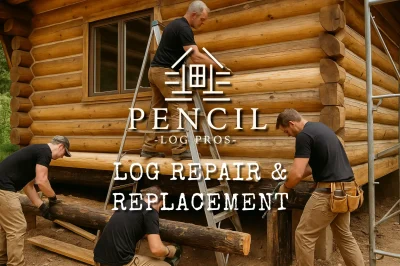












Log repair and log replacement done right means the difference between a log home that lasts generations and one that costs tens of thousands of dollars in preventable damage. Pencil Log Pros delivers professional log repair and log replacement services for log homes, cabins, and mountain properties throughout Colorado—work that addresses the root causes of damage, restores structural strength, and protects your investment for the long term. Led by Brad Siler, a Certified Licensed General Contractor (Class C), Pencil Log Pros is Colorado’s #1 log home restoration company, trusted by homeowners, property managers, and estate owners who want the job done right the first time.
Whether your logs are showing early warning signs or have suffered extensive rot, insect damage, or structural failure, this page gives you everything you need to make an informed decision—what to look for, what the process involves, what it costs, and how to choose the right contractor. If you’re ready to act, contact Pencil Log Pros to schedule your on-site log inspection and get an honest, detailed assessment of what your home needs.
Why Log Repair & Replacement Matter More Than Most Homeowners Realize
Log homes are structurally different from stick-frame construction. The logs themselves are the walls—they carry the load, resist the elements, and define the thermal envelope of the home. When a log deteriorates, the consequences go beyond cosmetics. A soft, rotted log can compromise load-bearing capacity, create pathways for water infiltration, attract insects, and accelerate deterioration in adjacent wood. What starts as a surface problem can quickly become a structural problem.
The good news: when caught early, most log damage can be addressed with targeted repairs that restore both function and appearance without a full replacement. When damage is severe or widespread, Pencil Log Pros has the equipment, expertise, and structural know-how to remove and replace entire logs safely—even in load-bearing walls and corners—while keeping the rest of your home intact and protected.
Delaying repairs is almost always more expensive than addressing damage promptly. Rot spreads. Insects bore deeper. Moisture penetrates further. A repair that costs a few thousand dollars today can become a $20,000 or $30,000 replacement project if left untreated for another season or two. Pencil Log Pros gives you a clear picture of what your home needs now versus what can wait, so you can plan and budget for log repair or log replacement effectively.
Signs Your Log Home Needs Professional Repair or Replacement
Log damage doesn’t always announce itself dramatically. Many of the most serious problems develop gradually and stay hidden until they’ve advanced significantly. Knowing what to look for helps you catch issues early—before they escalate. Here are the most common warning signs that indicate your log home needs professional attention:
Soft or spongy wood: Press your thumb or a screwdriver firmly into the surface of your logs, especially at the ends, around windows and doors, and near the foundation. If the wood gives, crumbles, or feels soft, rot has penetrated the log. Surface hardness doesn’t guarantee structural integrity—a log can look fine on the outside while being completely hollow from rot inside.
Visible checks, cracks, and splits: Logs naturally develop checks (surface cracks) as they dry and cure. Small, shallow checks are normal. Deep longitudinal cracks, especially those that open upward, collect water and accelerate decay. Cracks that run across the grain, gaps at log ends, or splits that expose the log’s interior require immediate professional evaluation.
Dark staining, discoloration, or mold: Black, gray, or green staining on log surfaces—particularly in areas that stay shaded or damp—indicates moisture retention and likely fungal growth. Surface mold can often be cleaned and treated, but if staining goes deep or returns after treatment, there’s a chronic moisture problem that needs to be diagnosed and resolved.
Sawdust trails, small holes, or frass: Fine sawdust on or below logs, tiny circular holes in log surfaces, and small piles of debris (called frass) are telltale signs of wood-boring insects. Carpenter ants, powder post beetles, and other species can hollow out logs from the inside while leaving the exterior largely intact. By the time visible damage is obvious, infestation is often widespread.
Gaps between logs, drafts, or cold spots: Settling, shrinkage, and chinking failure can create gaps between logs that allow outside air, moisture, and pests to enter the home. If you feel drafts near log walls, notice cold spots in certain rooms, or see daylight between logs, it’s time for a professional inspection to assess whether chinking, caulking, log repair, or log replacement is the right solution.
Sagging, bowing, or wall separation: Any visible change in the geometry of your log walls—walls that appear to bow outward, corners that no longer meet squarely, or any settling that affects doors and windows—is a serious structural warning sign. These conditions require immediate professional assessment.
If you’re seeing any of these signs, don’t wait. Pencil Log Pros offers detailed log home inspections and thermal imaging to identify damage that isn’t visible to the naked eye, including hidden moisture pockets, internal rot, and insulation failures behind finished surfaces.
What Causes Log Damage in Colorado Log Homes
Colorado’s climate creates a uniquely challenging environment for log homes. The combination of high UV exposure at elevation, wide temperature swings between day and night, heavy snowpack, freeze-thaw cycles, and dry summers creates conditions that accelerate wear on log surfaces and structural elements. Understanding the primary causes of log damage helps homeowners take a proactive approach to maintenance and early intervention.
According to the Log Homes Council, proper maintenance is the single most effective way to extend a log home’s lifespan. Moisture and water infiltration are the single most common cause of log deterioration. Water enters logs through checks, failed chinking and caulking, poorly detailed rooflines, foundation splash-back, and any area where the protective stain or sealant coating has failed. Once inside the log, moisture creates the conditions for fungal decay and rot. In Colorado’s freeze-thaw climate, water that penetrates logs can freeze and expand, widening cracks and accelerating structural breakdown.
UV damage is especially significant at Colorado’s higher elevations, where solar intensity is substantially greater than at sea level. UV radiation breaks down the lignin in wood, causing graying, surface checking, and the breakdown of protective coatings. Logs that haven’t been properly stained and sealed within the last three to five years are highly vulnerable to accelerated UV deterioration, which can open the door to moisture and insect damage.
Wood-boring insects, including carpenter ants, powder post beetles, bark beetles, and wood wasps, are active throughout Colorado’s mountain communities. These insects don’t just damage logs—they can structurally compromise them, creating internal voids that are impossible to detect without probing or advanced inspection techniques. Untreated infestations that persist for multiple seasons often require complete log replacement rather than repair.
Fire and smoke damage present a specific challenge for log structures. Even after a fire is extinguished, heat-stressed and charred logs may retain structural integrity issues that aren’t immediately visible. Pencil Log Pros provides smoke and fire damage restoration services, assessing structural integrity and replacing logs compromised by heat and combustion.
Deferred maintenance is a contributing factor in the majority of serious log home damage cases. Log homes require regular maintenance cycles—cleaning, re-staining, chinking inspection and replacement, caulking, and sealant application—every three to seven years, depending on exposure. Homeowners who skip or delay these cycles are significantly more likely to face expensive repair or replacement work as a result.
Log Repair: What the Process Involves
Log repair is the preferred solution when damage is localized, hasn’t compromised the structural integrity of the log, and can be fully remediated without removing the log from the wall. Pencil Log Pros uses a systematic, proven repair process that restores both function and appearance:
Inspection and damage assessment: Every repair begins with a thorough inspection of the affected area. Brad Siler personally evaluates the extent and depth of damage using probing tools, moisture meters, and in many cases, thermal imaging to identify hidden moisture or rot. This assessment determines whether repair or replacement is the right approach and informs a detailed scope of work.
Removal of deteriorated material: All rotted, soft, or insect-damaged wood is carefully removed using chisels, grinders, or specialized excavation tools. It’s critical to remove all compromised material—leaving even small amounts of rot can allow it to continue spreading beneath the repair surface. After excavation, the cavity is treated with borate-based preservatives that penetrate the surrounding wood, providing lasting protection against future fungal and insect activity.
Structural reinforcement when needed: For logs with significant internal voids or compromised load paths, Pencil Log Pros may use structural epoxy consolidants to harden and stabilize degraded wood fibers before filling. In some cases, supplemental support or sister logs may be installed to restore the log’s load-bearing capacity before surface repairs are completed.
Fill and rebuild: Depending on the depth and profile of the damage, voids are filled with specialized epoxy wood filler, borate-treated filler compounds, or—for larger voids—salvaged or milled wood that matches the species and grain of the original log. Each repair is shaped, carved, and textured to replicate the natural surface character of the surrounding logs.
Sanding, staining, and sealing: The repaired area is sanded smooth, blended to match the surrounding surface profile, and finished with stain and sealant that matches the rest of the home’s exterior. Pencil Log Pros uses premium-grade log home stains and coatings that provide UV protection, water resistance, and long-lasting color retention. The goal is a repair that’s virtually invisible—restoring both the structural function and the visual continuity of the home.
Log Replacement: When It’s Necessary and What to Expect
Full log replacement becomes necessary when damage has progressed to the point where repair can’t safely or effectively restore structural integrity or when the scope of rot or infestation is too extensive for a fill-and-seal approach. Common situations that require full log replacement include:
Logs with severe structural rot that has compromised the majority of the log’s cross-section; logs with extensive insect tunneling that has created internal voids too large for epoxy consolidation; logs that were damaged by fire or extreme heat; logs showing full-length splitting or separation; and wall sections where multiple adjacent logs are damaged and repair of individual logs is less efficient or less structurally sound than replacing the entire run.
Log replacement is a complex, technically demanding process that requires professional expertise, proper equipment, and a thorough understanding of log home structural systems. Here’s how Pencil Log Pros approaches it:
Structural preparation and temporary support: Before any load-bearing log is removed, Pencil Log Pros installs temporary support systems—including support jacks, headers, and lateral bracing—to transfer the structural load safely while the damaged log is removed and the replacement is installed. This phase is critical and must be done correctly to prevent damage to the surrounding structure during the replacement process.
Precision removal: The damaged log is carefully cut free from adjacent logs, chinking, caulking, and any mechanical fasteners. Removal is done methodically to minimize disruption to the surrounding structure and to preserve the integrity of the logs above and below the one being replaced.
Custom log matching: Replacement logs are sourced and milled to match the original log’s species, diameter, profile, and character as closely as possible. For homes with distinctive original timber—hand-peeled logs, D-logs, round logs, or square-hewn timbers—Pencil Log Pros works with specialty sawyers and log suppliers to find matching material. In some cases, logs are hand-shaped and textured to replicate the look of aged, original timber.
Installation and structural integration: The new log is installed using the same joinery, fastening, and connection techniques appropriate for the original construction method. Proper bearing, clearances, and connections are verified before temporary supports are removed.
Chinking, caulking, and sealing: After the structural work is complete, all joints, gaps, and connections around the new log are chinked, caulked, and sealed to prevent moisture infiltration and air infiltration. This work integrates seamlessly with any needed updates to the surrounding chinking system. Learn more about our log chinking and sealant services.
Finishing: The new log is sanded, stained, and sealed to match the surrounding logs. When replacing logs in a weathered home, achieving a color match often requires multiple stain applications and careful blending to make the new log look like it’s been there for decades. Pencil Log Pros takes pride in finishes that are virtually indistinguishable from the original work. Learn more about our log staining and clearcoat services.
Preserving Historical and Heritage Log Structures
Colorado is home to a remarkable collection of historic log structures—pioneer cabins, mining-era homesteads, mountain lodges, and ranches that are decades or even centuries old. Repairing and restoring these structures requires more than technical skill; it requires sensitivity to the original construction methods, materials, and the building’s character.
Pencil Log Pros has experience working on heritage log structures where the goal isn’t just functional restoration but authentic preservation. This includes sourcing period-appropriate wood species, replicating hand-hewn or hand-peeled finishes, using historically compatible chinking materials, and documenting the condition and work performed for properties with historical significance. Our historical preservation services are tailored to the specific needs of Colorado’s historic log building stock.
Complementary Services That Maximize the Value of Your Repair Investment
Log repair and log replacement projects often reveal or create opportunities to address related maintenance needs that, if addressed simultaneously, significantly extend the life and performance of the work. Pencil Log Pros integrates the following services with log repair & replacement projects as needed:
Log chinking and sealant work ensure that gaps created or exposed during repair are properly sealed against air and water infiltration. Chinking applied after log repair creates a unified, weather-tight envelope that dramatically improves energy performance and moisture protection.
Log staining and clearcoat are often performed in conjunction with repair and replacement work to ensure a uniform appearance across the entire structure and to apply a fresh protective coating that guards against UV, water, and biological damage.
Log home inspections and thermal imaging can be performed before, during, or after repair work to verify that no hidden damage was missed and to establish a baseline condition record for future maintenance planning.
Ongoing maintenance programs from Pencil Log Pros protect your repair investment by establishing a regular schedule of inspection, cleaning, re-staining, and chinking maintenance—preventing the conditions that lead to future repair needs.
How Much Does Log Repair and Replacement Cost in Colorado?
Cost is one of the most common questions homeowners ask when they first contact Pencil Log Pros—and it’s a fair one. Log repair and replacement costs vary significantly based on the extent and type of damage, the accessibility of the affected area, the number of logs involved, the species and dimensions of replacement logs required, and the finishing work needed. Here’s a general framework to help set expectations:
Minor log repairs involving small areas of surface rot or localized insect damage typically start in the range of a few hundred dollars per repair area. More significant repairs involving deep excavation, structural consolidation, and blended finishing can run several thousand dollars per log. Full log replacement—particularly for large-diameter logs, corner logs, or logs in difficult-to-access locations—ranges from several thousand dollars per log for straightforward replacements to significantly more for complex structural work on multiple logs or load-bearing walls.
Pencil Log Pros provides detailed, written estimates before any log repair or log replacement work begins. There are no hidden fees, no vague scopes of work, and no surprises at the end of the job. Brad Siler reviews every estimate personally to ensure it accurately reflects what the home needs and what the work will cost. If you’re working with a budget, Pencil Log Pros can help you prioritize work in phases—addressing the most urgent structural and moisture issues first and scheduling cosmetic finishing work in subsequent seasons.
Why Colorado Log Home Owners Choose Pencil Log Pros
There is no shortage of general contractors in Colorado, and some will attempt log home repair work. But log home restoration is a specialized trade—one that requires specific knowledge of log species behavior, structural log joinery, moisture dynamics in wood, appropriate repair materials, and the finishing techniques that make repairs look seamless. Hiring a generalist for log home repair is one of the most common mistakes homeowners make, and it often results in repairs that fail prematurely, don’t address root causes, or visually stand out in ways that detract from the home’s appearance.
Pencil Log Pros is different. As Colorado’s #1 log home restoration company, Pencil Log Pros brings:
Licensed, certified expertise: Brad Siler holds a Class C Certified Licensed General Contractor credential, which means every project is managed by someone with verified competency in structural construction practices. This matters enormously when logs are being removed from load-bearing walls or when structural assessments are part of the scope.
Specialized log home knowledge: Pencil Log Pros works exclusively in the log home space. That depth of focus translates into better diagnostics, better material selection, better repair techniques, and better long-term outcomes for your home.
Transparent, detailed project management: From the initial inspection through the final walkthrough, Pencil Log Pros provides clear communication, documented scopes of work, and honest guidance on what your home needs now and what it will need in the future. No pressure, no upselling, no vague answers.
Quality materials and craftsmanship: Pencil Log Pros uses only premium-grade repair compounds, structural epoxies, borate treatments, and exterior log finishes. The goal is a repair that performs for decades—not one that gets you through the next season before failing again.
Colorado-specific experience: Log homes in Colorado face unique challenges related to altitude, UV intensity, freeze-thaw cycles, and high-country moisture dynamics. Pencil Log Pros has direct, hands-on experience with these conditions across log homes throughout the Colorado mountains and Front Range.
If you’d like to learn more about whether your logs can be repaired or need replacement, our log home consulting services offer expert second opinions and practical restoration planning tailored to your budget and timeline.
Schedule Your Log Repair and Replacement Inspection
The best time to address log damage is before it spreads. Whether you’re seeing obvious signs of deterioration or you simply haven’t had a professional inspection in several years, contacting Pencil Log Pros is the right first step. Brad Siler and the Pencil Log Pros team will evaluate your home honestly, explain your options clearly, and give you the information you need to protect your investment—without the pressure tactics or one-size-fits-all recommendations you might get elsewhere.
Contact Pencil Log Pros today to schedule your on-site log inspection and get a detailed, written assessment of your home’s condition and the log repair or log replacement work it needs. We serve log home owners throughout Colorado, from the Front Range to the Western Slope, from ski country cabins to high-elevation retreats and historic mountain properties.