
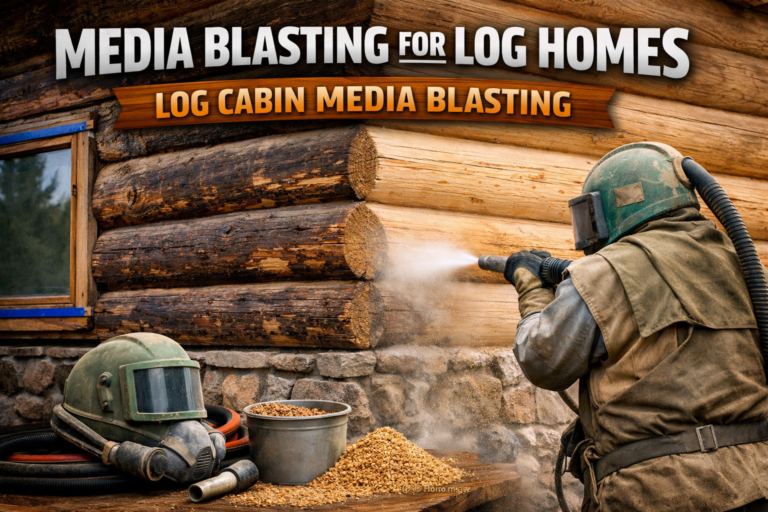
Media Blasting for Log Homes in Colorado: The Smart Way to Strip, Restore, and Re-Stain Without Ruining Your Logs – Colorado log homes are built for beauty, but they live in one of the toughest climates in the country. At 5,000–10,000+ feet, UV intensity climbs fast, winter snow piles up, and freeze-thaw cycles stress every seam, check, and corner. When stain starts peeling or the wood turns gray and chalky, the most reliable reset is often media blasting for log homes.
This guide explains what log cabin media blasting actually is, when it’s the right choice, and how to follow it with the correct repairs, staining, and sealing so your restoration lasts. If you want your logs to look clean, consistent, and protected—without flattening the log profile—this is for you.
Why Colorado Weather Breaks Down Log Home Finishes So Fast
Log homes don’t fail because they’re “high maintenance.” They fail because their surfaces are constantly attacked by sun and moisture in cycles. Colorado’s elevation and dry air can make wood look fine for a while, right up until the finish gives up suddenly.
Here are the biggest local factors that make media blasting for log homes such a common restoration step in Colorado.
- High-elevation UV exposure: South and west walls can fade and oxidize quickly, especially above 7,000 feet.
- Snow and ice load: Snow stacks at lower courses, porches, and deck connections where rot often begins.
- Freeze-thaw cycles: Water expands in checks and gaps, widening openings and stressing sealants.
- Wind-driven dust: Fine grit embeds into old coatings and grain, creating blotchy, grimy color.
- Big daily swings: Warm sun and cold nights cause wood movement that cracks failing coatings.
When the surface is too uneven, too layered, or too oxidized for washing and sanding, log cabin media blasting becomes the cleanest path back to healthy wood.
What Is Media Blasting for Log Homes?
Media blasting is a controlled stripping process that uses compressed air to propel a chosen blasting media against the log surface. The goal is to remove failing stain, oxidation, embedded grime, and surface contamination without gouging the wood.
Log cabin media blasting is especially effective because it reaches grooves, corners, notches, and log-to-log seams where sanding often leaves residue. Done correctly, it creates a consistent surface that accepts new stain evenly.
One important distinction: this is not the same thing as harsh sandblasting. Professional media blasting for log homes is about selecting the right media, controlling pressure, and protecting the log profile while achieving a uniform strip.
When Log Cabin Media Blasting Is the Right Choice
Not every cabin needs blasting. But if your exterior has reached the “patchwork” stage, log cabin media blasting is often the most cost-effective option because it prevents early finish failure.
- Peeling, flaking, or cracking stain: Especially on sun walls where the coating is brittle.
- Multiple layers of stain or paint: Built-up coatings that washing can’t remove uniformly.
- Gray, chalky oxidation: Wood fibers have degraded and won’t hold stain consistently.
- Blotchy color from past repairs: Different products and colors over time create a mismatched exterior.
- Embedded grime or organic staining: Dust, soot, or mildew staining that stays after cleaning.
If you’ve tried cleaning and spot sanding and the result still looks uneven, that’s usually your sign that media blasting for log homes is the better “reset button.”
Why Prep Quality Matters More Than the Stain Brand
Most coating failures start with poor adhesion. And poor adhesion usually starts with a surface that isn’t truly clean or consistent. A fresh coat over a mixed surface can look fine for a season, then peel or fade fast.
Media blasting for log homes solves this by removing what’s failing and exposing sound wood. Then stain can penetrate more evenly and bond better. That’s why media blasting is often the foundation of a long-lasting restoration system, not a standalone service.
Restoration Workflow: How Media Blasting Fits Into a Full Log Home Restoration
The best results come when media blasting is part of a step-by-step plan: evaluate, strip, repair, seal, and finish. Below is the restoration workflow Pencil Log Pros uses on Colorado cabins and log homes.
Step 1: Inspection and Surface Diagnosis
Before log cabin media blasting begins, the first job is to identify what’s on the logs. Oil-based stains, acrylic stains, and paints each strip differently. We also look for soft spots, failed caulking lines, and rot-prone areas like log ends and lower courses.
This diagnosis determines media choice, pressure settings, containment needs, and how much repair work should be planned after media blasting.
Step 2: Masking, Protection, and Jobsite Control
Great blasting starts with great protection. Windows, doors, stone, lighting, landscaping, and hardware should be shielded so media stays where it belongs. Containment matters for clean results and an efficient finish phase.
Media blasting is only as clean as the prep and protection behind it.
Step 3: Controlled Media Blasting for Log Homes
This is where experience shows. Technique matters: nozzle distance, angle, and consistency are what protect the log’s character. The goal is clean, uniform wood—not carved grain or flattened faces.
Professional media blasting for log homes removes failing coatings while preserving the natural shape of pine, cedar, and spruce logs.
Step 4: Detailed Cleanup and Blow-Out
After log cabin media blasting, media can hide in checks, seams, notches, and corners. Proper blow-out and cleanup keeps the surface clean for stain and prevents leftover grit from interfering with chinking and sealant bonding.
Clean wood deserves a clean finishing environment. Cleanup is part of the quality of media blasting for log homes, not an afterthought.
Step 5: Rot Repair and Wood Restoration
Once the old finish is gone, the truth shows up. That’s a good thing. Media blasting for log homes reveals soft areas, failed patches, and water intrusion points that were previously hidden.
Pencil Log Pros performs rot repair, dutchman repairs, and selective log replacement when needed. Fixing the wood first ensures your new stain and sealant system is protecting solid material, not covering problems.
Step 6: Chinking, Caulking, and Sealing the Vulnerable Details
Many Colorado log homes need attention around windows, doors, log-to-trim transitions, and settling gaps. Chinking and caulking help control air leaks and moisture intrusion, especially through windy winters.
Log cabin media blasting improves bonding because chinking and sealants adhere best to properly prepped surfaces. When sealing is done after media blasting for log homes, it tends to last longer and look cleaner.
Step 7: Staining and Protecting the Logs
Stain is your UV shield and moisture manager. After media blasting for log homes, the wood is ready to absorb stain more evenly, which helps color uniformity and long-term adhesion.
In Colorado, stain selection should account for sun exposure, elevation, and whether your home sits in deep shade or full wind. The right product matters, but the surface created by log cabin media blasting is what helps the stain perform.
Choosing the Right Media for Log Cabin Media Blasting
The word “media” is the key. Different blasting media behave differently, and the best choice depends on the coating type and wood condition. Skilled media blasting for log homes uses the gentlest effective media and adjusts settings to protect the logs.
Common Gentle Media Options for Log Homes
- Walnut shell: Often used for controlled stripping with reduced risk of scarring.
- Corn cob: Effective for many stains and oxidation while staying relatively gentle.
- Soda (in specific cases): Useful for certain contamination issues, with proper follow-up cleaning.
For many cabins, these options make log cabin media blasting efficient without being harsh on softwood grain.
More Aggressive Media (Used Selectively)
- Crushed glass: Can be effective on heavy buildup, but must be controlled carefully.
- Mineral abrasives: Typically reserved for special conditions and handled with caution.
If your home is cedar, pine, or spruce, the wood may be softer than it looks—especially on sun-baked walls. That’s why professional media blasting for log homes should prioritize control over speed.
What Media Blasting for Log Homes Can Reveal (And Why That’s Good)
Homeowners sometimes worry when blasting “shows more.” But visibility is the point. A restoration should be based on real conditions, not hidden decay.
After media blasting for log homes, it’s common to discover:
- Small rot pockets at log ends and lower courses
- Failed caulking lines around doors and windows
- Old repairs that need correction
- Checks that should be sealed or managed
- Moisture pathways around deck connections
Log cabin media blasting helps you fix the real causes of finish failure so your next stain cycle lasts longer.
Mobile Options: When You Need On-Site Capability
Many Colorado cabins sit on tight mountain roads or remote lots where hauling materials is challenging. That’s why mobile setups matter. If you’re researching on-site solutions, Pencil Log Pros can help you understand what to expect from mobile media blasting and how to plan prep, access, containment, and cleanup.
Whether you call it media blasting for log homes or log cabin media blasting, the result should be the same: a clean, consistent surface that’s ready for repairs and a finish system built for mountain conditions.
Services Pencil Log Pros Often Combines With Log Cabin Media Blasting
Blasting is usually one piece of the exterior puzzle. Pencil Log Pros provides full-scope restoration so you don’t have to schedule multiple contractors and hope their work aligns.
- Media blasting for log homes and full surface prep
- Log cabin media blasting for cabins, lodges, and timber features
- Log home staining and protective finishing systems
- Chinking installation and chinking repair
- Caulking and sealing at windows, doors, and log interfaces
- Rot repair, dutchman repairs, and selective log replacement
- Deck refinishing (rails, posts, stairs, and walking surfaces)
- Ongoing maintenance plans and touch-up strategies
Project Scenarios: Where Media Blasting Makes the Biggest Difference
Here are common real-world situations where media blasting for log homes delivers noticeably better outcomes than washing and spot sanding.
Scenario 1: The South Wall That Never Matches
You re-stain the south wall, but it still looks uneven. That usually means the surface has layered products and oxidation that prevent uniform absorption.
Log cabin media blasting removes the mismatch at the source. The new stain can penetrate evenly, and the wall stops looking like it has “bands” of different color.
Scenario 2: Old Dark Finish With Heavy Buildup
Dark stains can look sharp in the mountains, but they also show every defect when they fail. When buildup is thick, spot repairs rarely blend well.
Media blasting for log homes resets the surface so your new finish looks intentional across the entire exterior.
Scenario 3: Cabin Grime From Dust, Wind, and Trees
Foothill and mountain cabins can collect grime that becomes part of the coating. Pressure washing might lighten it, but the blotchiness remains.
Log cabin media blasting lifts embedded contamination and opens the wood for a stain system that bonds cleanly.
Scenario 4: Restoration Prep Before New Chinking
If you’re planning chinking repair or a full re-chink, bonding matters. Old coatings and oxidation reduce adhesion and shorten service life.
By starting with media blasting for log homes, you create the clean substrate chinking and sealants need.
Homeowner Tips to Protect Your Investment in Media Blasting
Media blasting for log homes is a powerful tool, but the best outcomes happen when the project is planned as a system. These tips help you avoid shortcuts that lead to early failure.
- Ask what media will be used. Good log cabin media blasting includes a media plan, not vague promises.
- Ask how the crew avoids wood damage. Pressure, nozzle distance, and technique matter.
- Confirm containment and cleanup. Blasting should not leave media packed into checks and seams.
- Don’t skip repairs. Blasting reveals issues for a reason—fix them before you stain.
- Plan sealing and chinking. Water intrusion and air leaks can undo a beautiful finish fast.
- Don’t rush stain timing. Wood should be clean and appropriately dry after media blasting for log homes.
If a bid focuses only on blasting speed and ignores repair and finish strategy, that’s a red flag. Quality log cabin media blasting is controlled, not chaotic.
Why Choose Pencil Log Pros for Media Blasting for Log Homes
Pencil Log Pros is Colorado-based and focused on log home restoration—not generic exterior work. That matters because logs require a different mindset: protect the profile, manage moisture pathways, and build a finish system that can handle UV and snow.
- Log-specific expertise: We understand pine, cedar, and spruce behavior in mountain exposure.
- Controlled blasting approach: media blasting for log homes should clean wood, not damage it.
- System-first restoration: log cabin media blasting plus rot repair, sealing, chinking, and staining.
- Detail work that lasts: We focus on vulnerable areas like log ends, lower courses, and window transitions.
- Long-term thinking: We help homeowners plan maintenance intervals to protect the investment.
Your log home should look natural and feel solid. Our goal is to deliver a restoration that performs in Colorado, not just a quick cosmetic change.
Nearby Colorado Service Areas for Log Cabin Media Blasting
Pencil Log Pros serves log homeowners across the Front Range, foothills, and mountain communities. Start here to explore our coverage: /locations/.
We frequently work in and around:
If you’re outside these towns, reach out anyway. Many owners search for media blasting for log homes when a cabin is remote, weathered, or hard to access. We’re used to Colorado logistics, and we plan projects accordingly.
Get Your Logs Back to Clean Wood and Build a Finish That Holds Up
If your stain is peeling, your exterior looks blotchy, or your logs are gray and chalky, it may be time for media blasting for log homes. When done with control and followed by proper repairs and finishing, log cabin media blasting creates the most reliable foundation for a long-lasting restoration.
Pencil Log Pros can evaluate your log home, recommend the right blasting approach, repair damaged wood, and apply a stain and sealing system built for Colorado elevation and exposure. If you’re ready to stop chasing short-lived re-stains and start protecting your logs the right way, we’re ready to help.
FAQ: Media Blasting for Log Homes and Log Cabin Media Blasting
Is media blasting for log homes safe for older logs?
Yes, when done correctly. The safety comes from using the right media, controlled air pressure, and proper technique. Professional media blasting for log homes should remove failing coatings without gouging the log surface.
Will log cabin media blasting remove paint?
In many cases, yes. Paint often requires a more strategic approach than stain, including careful media selection and technique. A properly planned log cabin media blasting project can remove paint while still protecting the wood profile.
Does media blasting raise the grain or make logs look fuzzy?
It can if the settings are too aggressive or the wrong media is used. High-quality media blasting for log homes aims for a clean, consistent surface with minimal fiber damage, followed by detail prep as needed.
How soon can you stain after log cabin media blasting?
Timing depends on conditions and moisture. Colorado sun can dry exposed walls quickly, while shaded sides may hold moisture longer. After log cabin media blasting, staining should happen when the surface is clean and appropriately dry for strong adhesion.
Is pressure washing enough instead of media blasting for log homes?
Pressure washing is great for maintenance, cleaning, and light oxidation. But when coatings are layered, peeling, or blotchy, media blasting for log homes usually creates a more uniform base for staining and longer-lasting results.
Do I need to chink after media blasting for log homes?
Not always, but it’s common to address gaps and failing chinking once the surface is properly stripped. Media blasting for log homes can reveal areas where sealing or chinking repair will prevent moisture intrusion and improve comfort.
What’s the biggest mistake homeowners make after log cabin media blasting?
The biggest mistake is rushing the finish phase or skipping repairs. Log cabin media blasting sets the stage, but rot repair, sealing details, and proper stain application are what make the restoration last.