
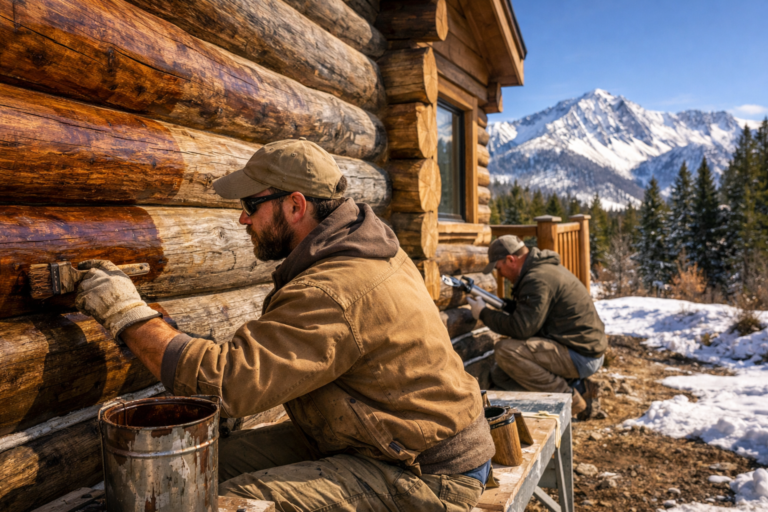
If you’re searching for log home restoration cost or log cabin restoration cost, you’re probably trying to answer a straightforward question: “What will it take to get my logs back to healthy, protected, and good-looking again?”
In Colorado’s high-elevation climate, that answer is almost never one-size-fits-all. Intense UV exposure, wide temperature swings, wind-driven precipitation, heavy snow loads, and freeze-thaw cycles can turn “minor wear” into real damage faster than many homeowners expect.
This guide breaks down the real factors that drive restoration scope (and therefore cost) without throwing out misleading averages. If you want a clear, written plan tailored to your home’s condition, the fastest path is a professional evaluation and a free estimate based on what’s actually happening on your walls.
Why Log Home Restoration Cost Is So Hard to Compare Online
Most online “cost” answers assume every log home is the same. In reality, log restoration is a combination of surface prep, repairs, sealing, and a protective finish system—and each one changes depending on your home’s history and exposure.
Two cabins can look similar from the driveway and still require completely different levels of work once you examine the stain failure, moisture pathways, and the condition of the wood underneath.
- Condition matters more than size. A smaller cabin with rot at the lower courses can be more involved than a larger home with stable logs.
- Access changes everything. Steep terrain, multi-story gables, and limited staging areas can significantly affect how restoration is performed.
- Past coatings can make or break a project. Incompatible stains, peeling films, or layered products often require more intensive prep to restore the wood to sound condition.
Log Home vs. Log Cabin: What’s Different About Restoration Scope?
People often use “log home” and “log cabin” interchangeably. For restoration planning, the difference lies less in the label and more in construction details, footprint, and maintenance history.
When homeowners compare log cabin restoration cost to log home restoration cost, here are the common differences we see:
- Age and finish history: Cabins are often older, with multiple rounds of stain, spot repairs, and patchwork caulking.
- Site exposure: Cabins are frequently in more exposed locations—windy, snow-drift zones, and intense sun on south- and west-facing walls.
- Details and additions: Deck tie-ins, porches, and additions can create moisture traps where rot and staining failures start.
The takeaway: restoration is about the wood’s condition and the building’s water-management details, not the property’s name.
Colorado-Specific Challenges That Affect Log Cabin Restoration Cost
Colorado log homes face a unique blend of stressors. Elevation alone can amplify UV exposure, and the climate can swing from dry, warm afternoons to freezing nights.
- High UV and intense sun: South- and west-facing walls often fade and dry out faster, leading to premature stain breakdown.
- Freeze-thaw cycles: Water enters checks and joints, freezes, expands, and can widen splits or stress failing chinking lines.
- Snow load and drift zones: Lower logs can stay wet longer when snow piles up near walls, especially where rooflines dump snow.
- Low humidity + wind: Logs can dry aggressively, increasing checking and stressing weak sealant lines.
- Wildfire smoke and soot: Surface contamination can affect cleaning and adhesion if not handled correctly.
These factors are exactly why online “average cost” numbers don’t help. A proper plan comes from inspecting moisture risk areas and choosing the right prep and coating system for your exposure.
The Biggest Factors That Drive Log Home Restoration Cost
If you want to understand what you’re paying for, focus on the scope drivers below. They determine labor intensity, material needs, safety requirements, and the longevity of the finished system.
1) Log Condition: Surface Wear vs. True Wood Damage
Surface wear is common: fading stain, mild graying, light mildew, or small checks. Actual damage includes soft spots, punky wood, recurring black staining around joints, and signs of moisture intrusion.
Once prep begins, hidden issues may appear—especially around corners, butt joints, window/door transitions, and the base course where splash-back is common.
2) Prep Method: The #1 Difference Between “Quick Refresh” and Real Restoration
Prep is where restoration succeeds or fails. If a contractor skips the hard part, the finish can fail early—even if the stain is “high quality.”
- Media blasting: Often used to remove failing coatings and open wood pores for better penetration (when appropriate for your log condition).
- Chemical stripping: Useful for certain coating types or delicate areas, but requires careful neutralization and thorough rinsing.
- Controlled washing and agitation: Works for maintenance-level projects when the existing coating is stable and compatible.
The proper method depends on your existing coating, the condition of the wood, and the number of product layers on the logs.
3) Coating History: What Was Used Before (and How It’s Performing)
One of the most common “surprises” in log home restoration is discovering that the old finish is incompatible with a long-lasting system—or that it’s failing in a way that requires full removal.
Peeling, flaking, glossy films, or uneven blotching often signal that a straightforward recoat won’t hold. That pushes the scope toward deeper prep and more detailed surface correction.
4) Rot Repair and Moisture Corrections
Rot isn’t just a cosmetic issue. It’s a moisture-management issue.
When rot is present, the scope often includes locating the source (gutter overflow, splash-back, deck tie-ins, failed sealant, roof drainage patterns) and correcting it so the repair lasts.
- Common rot zones: lower courses, butt log ends, corners, window and door openings, and ledger/deck attachments.
- Repair types: epoxy consolidation (when appropriate), dutchman repairs, partial log replacement, or complete log replacement in severe cases.
5) Chinking, Caulking, and Sealing Needs
Sealants and chinking aren’t just for looks—they control air leakage and water intrusion. Failed lines can lead to drafts, moisture behind joints, and accelerated staining and rot.
Scope can range from targeted repairs to broader replacement, depending on adhesion, cracking, movement, and the condition of the substrate underneath.
6) Access, Height, and Safety Requirements
Two walls can have the same square footage but require very different setups if one is a walk-out basement with tall gables and steep terrain.
- Scaffolding vs. lifts
- Staging and material handling
- Protection of landscaping and nearby surfaces
- Complex rooflines and multiple elevations
Access isn’t a “small detail”—it’s a major planning factor in any accurate restoration scope.
7) Detail Work: Corners, Trim Interfaces, Checks, and Penetrations
Quality log restoration is detail-heavy. Corners, log-to-trim transitions, fastener points, knots, and checks all require the proper prep and sealing strategy.
This is where professional craftsmanship shows up—and where rushed jobs fail first.
What a Professional Restoration Scope Should Include (Even When You Don’t Want Price Guessing)
If your goal is to understand log home restoration cost without being misled, focus on whether the estimate includes the right steps and clear deliverables.
- Protection plan: masking, landscaping protection, containment where needed, and clean-up specifics.
- Prep plan: the method selected (and why), plus how failed coatings and problem areas will be handled.
- Repair plan: how rot and insect damage will be evaluated, documented, and repaired.
- Sealing plan: checks, joints, penetrations, and transitions around windows/doors and decks.
- Finish plan: product system approach, application method, and criteria for determining whether additional coats are needed.
- Maintenance guidance: what to watch for and how to extend the system’s lifespan.
If you’re comparing bids, comparing “what’s included” is far more helpful than comparing a single number with vague language behind it.
Step-by-Step: How Log Restoration Works (So You Understand the Scope)
Below is a typical flow for a correct restoration project. Not every home needs every step at the same intensity, which is precisely why an inspection matters.
Step 1: Inspection and Condition Mapping
A real inspection looks beyond surface color. It identifies where water is getting in, where wood is staying wet, and where failure is beginning.
- Moisture risk zones and likely water-entry points
- Stain performance on different elevations (sun vs. shade walls)
- Sealant and chinking condition
- Rot probing and repair planning
Step 2: Prep and Removal of Failed Coatings
This is where longevity is determined. Proper prep creates a stable surface so the new system can bond, penetrate, and protect.
It also reveals the wood’s actual condition. If a home has multiple layers of old product, prep often becomes the dominant scope driver.
Step 3: Repairs (Rot, Checks, and Problem Transitions)
Repairs aren’t just patch-and-go. Long-lasting repairs are paired with moisture corrections so the same area doesn’t fail again.
- Localized rot repair or log replacement as needed
- Addressing water traps (deck interfaces, splash-back zones, drainage issues)
- Stabilizing deep checking where it threatens water intrusion
Step 4: Chinking, Caulking, and Sealing
Sealing is protection, comfort, and efficiency. Done correctly, it helps prevent water entry and reduces drafts—especially in windy, cold conditions.
- Check sealing where appropriate
- Joint sealing at corners and log intersections
- Transitions around windows, doors, trim, and penetrations
Step 5: Staining and Protective Finish System
Application method matters, but system selection matters more. A finish should be chosen based on your exposure, your wood condition, and the performance you want over time.
Colorado homes often benefit from a system that balances UV resistance, breathability, and intense water shedding—without trapping moisture in the wood.
Step 6: Final Walkthrough and Maintenance Plan
At completion, you should know what was done, what areas were repaired, and what to watch for going forward.
A good maintenance plan prevents “full restoration” from becoming a frequent cycle.
Common “Surprises” That Change Log Cabin Restoration Cost (and How to Avoid Them)
Most surprise scope increases are avoidable when the initial inspection is thorough, and the estimate clearly defines what happens if hidden damage is found.
- Hidden rot behind trim: especially around windows, doors, and banding, where water sits.
- Deck ledger moisture intrusion: one of the most common sources of recurring damage.
- Failed sealant trapping moisture: old caulk lines can hold water where the wood can’t dry.
- Incompatible previous coatings: glossy, peeling films often require full removal to return to a stable system.
- Insect activity: carpenter bees and other pests can create entry points for moisture and staining.
The best way to avoid scope shock is to work with a company that can clearly explain the condition, the plan, and how they handle discoveries during prep.
How to Get an Accurate Log Home Restoration Estimate (Without Guesswork)
If you want a real answer to log home restoration cost, you need a scope built around your home—its condition, access, and exposure.
To speed up the estimate process, here’s what helps:
- Wide photos: each elevation, including gables and tall walls.
- Close-ups: black staining, soft wood, checking, peeling stain, failed chinking, and corner joints.
- History: when it was last stained/restored, and whether any blasting/stripping was done.
- Access notes: steep terrain, limited driveway access, landscaping constraints, and HOA requirements.
- Your goals: maintenance-level refresh vs. corrective restoration and repairs.
The more accurately a contractor can see the condition, the more accurate your scope will be from the start.
DIY vs. Hiring a Pro: The Real Risk Behind “Saving Money”
DIY can be reasonable for small maintenance tasks, but complete restoration is a different category—especially when rot, deep prep, or multi-story access is involved.
- Prep mistakes: inadequate removal of failing stain leads to early peeling, blotching, and rework.
- Product mismatch: applying the wrong system over an incompatible coating can fail quickly.
- Moisture misdiagnosis: treating discoloration without solving water entry can accelerate rot.
- Safety exposure: ladders, steep grades, and tall elevations create real risk.
When you’re searching “log cabin restoration cost,” it’s worth remembering that premature failure isn’t just a cosmetic issue—it can turn into repairs that would have been preventable with the proper prep and sealing strategy.
Smart Ways to Reduce Restoration Scope (Without Cutting Corners)
You can’t control sun exposure or snowfall, but you can reduce the conditions that keep wood wet and accelerate failure.
- Control splash-back: adjust grading, manage drip lines, and keep lower courses drier.
- Fix gutters and drainage: overflow patterns often show up as recurring dark staining.
- Trim vegetation: improve airflow and reduce shade-driven moisture retention near walls.
- Maintain sealant lines: address small gaps before water gets behind joints.
- Plan maintenance early: a timely maintenance coat can prevent deeper prep later.
These steps don’t replace restoration, but they can help keep restoration from becoming more repair-heavy over time.
Services Commonly Included in a Complete Restoration Plan
Restoration is often a combination of related services. If you want to see what Pencil Log Pros handles under one roof, visit our log home services page.
- Log home and log cabin restoration.
- Media blasting or stripping (when appropriate)
- Log staining and refinishing systems
- Chinking repair and replacement
- Rot repair and log replacement
- Check sealing and joint sealing
- Deck refinishing and tie-in moisture corrections
If you’d like a deeper overview of what complete restoration includes and how the process works, see our detailed page on log home restoration.
Example Project Scenarios (No Price Tags—Just What Changes the Scope)
These scenarios reflect the kinds of situations that lead to a single “cost” search yielding many different answers.
Scenario 1: Sun-Blasted Walls and Dry, Worn Logs
A home with heavy south/west exposure may have advanced UV damage even when other walls look fine. The scope often shifts toward deeper prep, more detailed check sealing, and a protective system designed for intense sun.
Scenario 2: Dark Staining at Lower Courses from Splash-Back
When the base logs stay wet from drainage and splash-back, discoloration can hide soft wood. The scope often includes moisture corrections and repairs before any finish system is applied.
Scenario 3: Drafts and Chinking Failure at Joints
When chinking is separating or failing broadly, the restoration plan may include targeted removal, substrate prep, and replacement—especially in areas where air leakage and moisture entry overlap.
Scenario 4: Peeling Film-Forming Finish from a Previous Contractor
If the old coating is peeling or forming a film that traps moisture, the project may require full removal to return to breathable, stable wood. This is one of the most common drivers behind “unexpected” restoration scope.
Questions to Ask Before You Choose a Log Restoration Contractor
When comparing options, the best question isn’t “What’s the cheapest?” It’s “Which plan will last and protect the wood?”
- What prep method are you recommending, and why is it right for my existing coating?
- How will you verify the condition of the wood and identify areas of rot risk?
- How do you handle hidden damage discovered during prep?
- What exactly is included for sealing checks, joints, and transitions?
- How will you protect landscaping, windows, and adjacent finishes during prep?
- What maintenance steps should I follow after completion?
A professional should be able to explain the “why” behind each step—because every step ties directly to durability and long-term value.
What Homeowners Can Do Before an On-Site Evaluation
If you want the most productive estimate visit, a little preparation helps. You don’t need to diagnose your home—just gather clues.
- Walk the perimeter and note where water flows during storms or snowmelt.
- Photograph any soft wood, dark staining, peeling finish, and failed sealant lines.
- Look closely at deck attachments, corners, and the bottom course of logs.
- Write down the year of the last stain (even if you’re not sure which product was used).
This information helps the restoration plan focus on root causes rather than just surface symptoms.
Why Homeowners Choose Pencil Log Pros for Restoration Planning
When people search “log home restoration cost,” they’re often trying to avoid surprises and avoid doing the work twice. The best way to do that is to start with an honest assessment and a clear scope.
- Inspection-first mindset: identify moisture pathways and failure points before choosing a finish system.
- Prep-focused quality: restoration lasts when prep is done right, not rushed.
- Repair capability: rot repair and corrections are handled as part of a real restoration strategy.
- Clear communication: you understand what’s included, why it matters, and how to maintain results.
Whether your project is a maintenance refresh or a corrective restoration with repairs, the goal is the same: protect the logs, stop the damage cycle, and give you a finish that holds up in Colorado conditions.
Colorado Service Areas for Log Home and Log Cabin Restoration
Pencil Log Pros is Colorado-based, serving mountain and Front Range communities where elevation, UV exposure, and snow load put log exteriors to the test.
If you’re not sure whether you’re in our service area, the simplest next step is a quick conversation and a look at your home’s condition so we can recommend the right restoration approach.
FAQ: Log Home Restoration Cost and Log Cabin Restoration Cost
Why does log home restoration cost vary so much from one home to another?
Because restoration isn’t a single service, it’s a combination of prep, repairs, sealing, and finishing—and each category expands or shrinks based on wood condition, previous coatings, and access.
Is log cabin restoration cost usually lower because cabins are smaller?
Not always. Smaller homes can still require intensive prep, major sealing work, or repairs—especially if the cabin is older, more exposed, or has moisture issues at lower logs and tie-in areas.
Can I get an accurate restoration cost from photos?
Photos can help narrow the likely scope, but the most accurate estimate comes from an on-site evaluation. Many of the biggest scope drivers—soft wood, trapped moisture, adhesion issues—are hard to confirm fully in pictures.
What’s the biggest cost driver in a log home restoration project?
In most cases, it’s prep. Proper removal of failing coatings and preparation of the wood surface is what allows the new system to bond and perform long-term.
Do chinking and caulking affect the restoration scope?
Yes. Failed chinking or sealant can create drafts and allow moisture into joints. Depending on the condition, the scope may include targeted repairs or more extensive replacement to restore a tight, protected envelope.
How do I know if my home needs rot repair?
Warning signs include soft wood, recurring dark staining in the same areas, crumbling fibers, and issues concentrated at the lower courses, corners, and around decks or openings. A professional inspection confirms the extent and the cause.
Will a “maintenance recoat” fix everything?
A maintenance recoat can be great when the existing system is stable and compatible. But if the coating is failing, peeling, or trapping moisture, recoating can lead to premature failure and wasted effort.
How can I make my restoration results last longer?
Keep logs drier by controlling drainage, maintaining gutters, trimming vegetation, and addressing small sealant failures early. Pair that with a finish system appropriate for your home’s exposure and condition.
Ready for a Real Answer on Your Restoration Scope?
If you’ve been searching for log home restoration cost or log cabin restoration cost, you already know the internet can’t see your home’s stain history, moisture risk zones, or hidden damage.
The fastest way to get clarity is a free, professional evaluation. Pencil Log Pros will assess your log condition, identify the primary failure points, and provide a clear restoration plan tailored to Colorado’s sun, snow, and elevation challenges.
When you’re ready, request a free estimate, and we’ll help you understand what your home needs now—and what will help you avoid repeat restoration cycles later.