
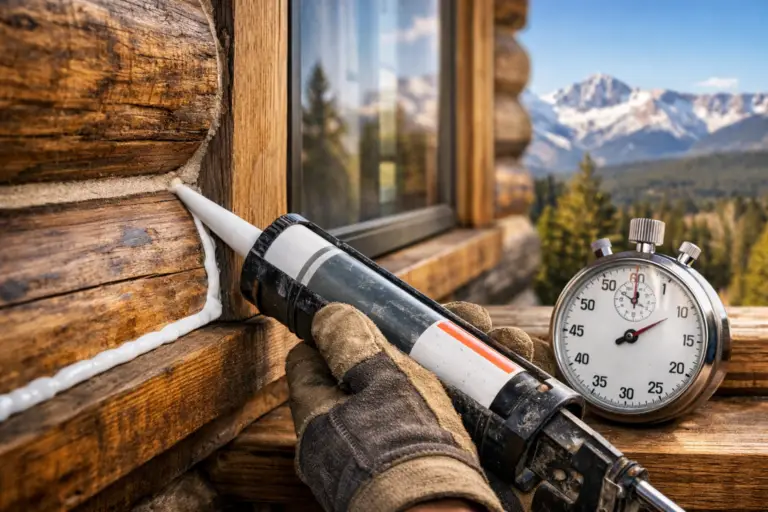
Log home caulking is typically touch-dry in 1 to 4 hours, safe from rain in 12 to 24 hours, and fully cured in 7 to 30 days depending on the sealant, bead depth, temperature, and humidity. On a Colorado log home the cure end of that range runs longer than the label suggests, because thick beads in dry, cool mountain air cure from the outside in.
Reviewed for technical accuracy by Brad Siler, Owner of Pencil Log Pros and Certified Licensed General Contractor, Class C.
That gap between “dry” and “cured” is where most log home caulking fails. A bead that feels firm on the surface can still be soft underneath, and if the logs move, it rains, or a freeze arrives before full cure, the seal tears loose from one side of the joint and the whole job has to be redone.
If you would rather have someone scope the sealant work on your home, a free consultation with Pencil Log Pros costs nothing, and the Log Home Repair Estimator gives you a ballpark in a few minutes.

How long does log home caulking take to dry?
Four different numbers get called “dry time,” and confusing them is what ruins beads.
Skin time — 20 minutes to 2 hours
The surface sets enough to resist dust and light contact. The bead underneath is still soft. Tooling has to happen before this, usually within 5 to 15 minutes of application.
Rain-safe time — 12 to 24 hours
The point where a shower will not wash out or pit the bead. On log home caulking this is the number that governs scheduling, because an afternoon mountain thunderstorm on a fresh bead means starting over.
Paint or stain-ready time — 24 hours to 7 days
Sealants must be cured enough to accept a finish. Coating too early traps solvent and causes the finish to crack or peel over the joint.
Full cure — 7 to 30 days
The sealant reaches its rated elasticity and adhesion. Until then it cannot handle the full movement a log wall puts through it.
Why log home caulking is not the same as household caulk
A bathroom joint is 1/8 inch wide and never moves. A log home joint can be an inch across and moves constantly. Logs shrink as they release moisture, swell when humidity rises, and settle for years after construction.
That means log home caulking has to stretch and recover, sometimes 50% or more of the joint width, across thousands of cycles. Standard acrylic latex has no chance. It goes hard, loses elasticity, and cracks away from the wood in a season or two.
Log home caulking uses elastomeric sealants engineered for that movement, and they cure slower than hardware-store products because the bead is far thicker and the chemistry is built for flexibility rather than speed. A 3/8 inch bead has roughly nine times the volume of a 1/8 inch bead. Cure time does not scale linearly — it scales badly.
Cure times by log home sealant type
Elastomeric log sealants and chinking
The products actually used for log home caulking. Skin in 1 to 2 hours, rain-safe in 12 to 24, full cure typically 2 to 4 weeks on a full-depth bead. Rated for high movement and formulated to bond to wood rather than sit on it. This is what belongs in a log joint, and it is what we use on log home caulking and chinking work.
Polyurethane
Skin in 1 to 2 hours, cure in 7 to 14 days. Strong adhesion and good movement tolerance, but many formulations chalk badly under high-altitude UV and are difficult to remove later.
100% silicone
Skin in 30 minutes, cure in 24 hours to 7 days. Fast and waterproof, but most silicones will not take stain or paint and bond poorly to weathered wood. Rarely the right choice for exterior log home caulking.
Siliconized acrylic
Skin in 30 minutes, cure in 3 to 7 days. Fine for interior trim. Not adequate for a moving exterior log joint.
Acrylic latex
Skin in 30 minutes, cure in 1 to 5 days. The fastest and the least suitable — minimal movement capability. Using it on a log wall is the single most common DIY log home caulking mistake.
What changes log home caulking cure time in Colorado
Label times are measured at roughly 70°F and 50% relative humidity. Almost nowhere in the Colorado high country is that.
Low humidity slows water-based sealants in a way people find backwards
Most log home caulking is water-based and cures by releasing moisture. In 15% humidity the surface flashes off fast and forms a skin over a soft core. It feels cured within hours and is not. Beads applied in very dry air routinely need double the label cure time all the way through.
Elevation and UV
UV intensity climbs roughly 4% per 1,000 feet. At 9,000 feet a fresh bead is taking far more radiation than the same product at sea level, and uncured sealant is at its most vulnerable. Direct afternoon sun on a south wall can skin a bead before it can be tooled.
Temperature swings
A 40-degree daily swing is normal in the mountains. The logs move while the sealant is still curing. Most products require surface temperature above 40°F throughout cure — not just at application. A 60°F afternoon that drops to 28°F overnight can stall or ruin a bead applied that day.
Bead depth and joint design
Deeper is not better. A bead that is too thick cures slowly and cannot flex properly. Correct log home caulking uses backer rod so the sealant bonds to two sides only, roughly half as deep as it is wide. Three-sided adhesion tears the bead apart the first time the log moves.
Rain and snow
Water on an uncured water-based bead washes out binder and leaves a chalky, weak seal that looks fine and fails within a year.
When to schedule log home caulking
In Colorado and the surrounding states, the reliable window runs late spring through early fall, and the best work happens outside the extremes of it.
Late May through September gives consistent overnight temperatures above 40°F. Within that, morning application on shaded elevations and afternoon application on walls already out of direct sun produces the most consistent cure. Chasing the sun around the house across a day is normal practice, not fussiness.
Avoid: any day with afternoon storms forecast inside the rain-safe window, the first cold snap of fall, and full sun on a south wall at midday.
For the wood-science background on moisture movement and coating performance, the USDA Forest Products Laboratory Wood Handbook covers it in depth.
Mistakes that ruin a log home caulking job
- Caulking over dirty, oxidized, or damp wood. Adhesion is everything. A perfect bead on a poorly prepped surface fails at the bond line, not in the sealant.
- Skipping backer rod. Causes three-sided adhesion and guarantees tearing.
- Using household caulk. No movement capability on a wall that never stops moving.
- Coating before full cure. Traps solvent, cracks the finish over every joint.
- Caulking over rot. Sealing moisture damage in accelerates it. Damage gets repaired first, then sealed.
- Tooling too late. Once a skin forms, tooling breaks it and the bead will not bond properly.
How to tell if your log home caulking has failed
You do not need a ladder for most of this. Walk the perimeter on a bright morning and look at the joints.
- A visible gap along one edge. The bead has released from the log on one side. This is adhesion failure and it is the most common form. Water is already getting behind it.
- Cracks running the length of the bead. The sealant has gone hard and lost elasticity. Usually means the wrong product was used, or it is simply past its life.
- Chalky, powdery surface. UV degradation, or a bead that got rained on before it cured.
- Dark staining below a joint. Water is tracking through and into the log. Check the wood, not just the sealant.
- Soft or spongy wood next to the joint. Stop. That is rot, and no amount of log home caulking fixes it. The wood has to come out first.
- Drafts or dust on the inside wall. If air moves through, water will too.
Failing joints on a house less than five years old point to an installation or product problem rather than age, and re-caulking without finding the cause just buys another short season. That diagnosis is what a full restoration assessment is for. If the joints simply need resealing, that is log home caulking work.
Frequently asked questions about log home caulking
How long does log home caulking take to dry before rain?
Plan on 12 to 24 hours before a fresh bead is safe from rain, and longer in cool or very dry conditions. This is the number that should drive scheduling on a log home caulking job in the mountains, because an afternoon thunderstorm on an uncured bead washes out binder and leaves a weak, chalky seal that fails within a season. If storms are forecast inside that window, the work waits.
Can you caulk a log home in cold weather?
Most log home caulking products require surface temperatures above 40°F for the entire cure period, not just at application. A warm afternoon followed by a hard overnight freeze can stall or destroy a bead applied that day. In Colorado that generally closes the reliable window from mid-fall to late spring. Some low-temperature formulations extend it, but they still need the logs themselves above minimum temperature.
How long before you can stain over log home caulking?
Between 24 hours and 7 days depending on the product, and longer for thick beads in dry air. Staining or painting before the sealant has cured through traps solvent under the finish, which cracks or peels over every joint within a year. When a schedule is tight, the correct sequence is to stain first and seal after, not to rush the cure.
How often does log home caulking need replacing?
A properly specified and correctly installed elastomeric sealant should last many years. Failure well before that usually points to a cause rather than age: wrong product, missing backer rod, poor surface prep, or logs moving more than the sealant was rated for. If seals are failing early on your home, the sealant is a symptom and the diagnosis matters more than a recaulk.
Is chinking the same as log home caulking?
They are related but not interchangeable. Chinking fills wide joints between logs and is textured to look like traditional mortar. Log home caulking handles narrower joints, checks, and butt joints, and is applied in smaller beads. Both are elastomeric and both need backer rod, and most log homes need both. Pencil Log Pros scopes them together rather than selling one and ignoring the other.
Get the sealant scoped right
Most failed log home caulking traces back to a decision made before anyone opened a tube — wrong product, wrong joint design, or wood that should have been repaired first. Book a free consultation with Pencil Log Pros and you will get an honest assessment of what your joints actually need, including whether the work can wait a season. Want a number first? The Log Home Repair Estimator takes a couple of minutes.